This is the second part of my blog about our trip to Georgia. For the first part, see
here
.
Mtskheta

|
|
Mtskheta, viewed from Jvari Monastery
|

|
Samtvaro Monastery, with
Wine Ice Cream
|

|
Bas-relief on the Samtvaro Monastery,
with inscription in Georgian
|
The next day saw us leave Tbilisi in the opposite direction, westwards to the town of Mtskheta. This was the capital of the region (confusingly called Iberia) around the second century AD. It had already been established as a town for a couple of thousand years - it claims to be the oldest continuously-inhabited town in the world, and is certainly way older than Tbilisi. It was the centre of the Christianisation of the country in the fourth century, so inevitably it has no shortage of monasteries and churches.
The most prominent is the Jvari Monastery, on a hilltop dominating the town and the confluence of the Aragvi and Mtkvari rivers, the latter continuing through Tbilisi and eventually draining into the Caspian Sea in Azerbaijan. The view is stunning. The monastery was built in the fourth century but soon proved to be too small. The current building dates from the 7th century. It was badly damaged by invaders - inevitable in Georgia - but survived with major repairs.
After Jvari we descended into town to admire the churches and monasteries to be found in the plain. The Samtvaro Monastery's associated church is huge. One of the striking features of Georgian churches is their bell towers. Unlike European ones, invisible from the interior, these rise high above the main part of the church, at the intersection of the nave and transept, supported by huge pillars integrated into the walls. They are very obvious from the outside, and truly awe-inspiring from the inside, as you gaze up into their heights. This church, being one of the biggest, has one of the most impressive.
As everywhere, this major tourist attraction is surrounded by gift-shops, cafés and so on. Everywhere sells something called wine ice-cream. I really meant to try it before we left, but never quite did.
Between monasteries we visited a very charming and interesting winery, in a private house a few kilometres from the town. We sat on a terrace overlooking the Mktvari river as we sampled the wines. The owner was a very interesting guy, a professor at the Technical University in Tbilisi who, very typically for Georgians, made small amounts of wine at his “country home”, where we were. He spoke good English although since we were supposed to be francophone, the conversation was a mixture of Georgian/French translation and just English.
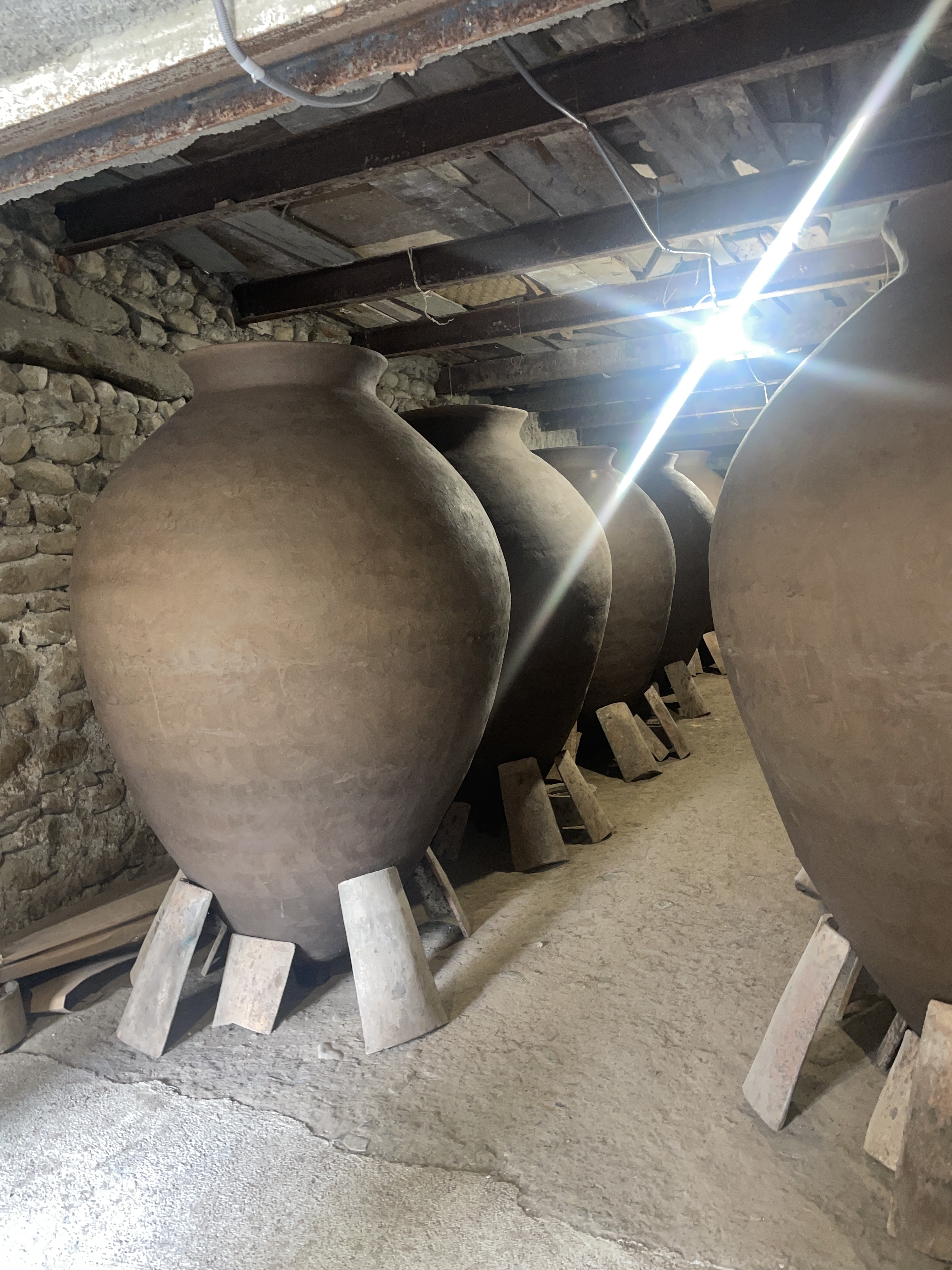
This was our first taste of wine made using the Kisi grape, another unique Georgian varietal - in a qvevri, of course. The qvevri gives body to any white-grape wine, but Kisi takes it a step further. It has masses of body and mouthfeel, and will stand up cheerfully even to red meat, as we discovered later. Then it was time for the cha-cha. He gave a rather poetic speech about how drinking it daily kept men young, and then it was time to drink. It was 60% alcohol, so the only way to drink it was to pour it down your throat without letting it touch the sides. Even so it was pretty potent.
He asked us to guess his age. I replied 65, and he looked disappointed. So I added, “But if I didn’t know about the cha-cha, I would have said 50”. That got a smile, a big laugh and we were friends again.
There was one more church to go before we returned to Tbilisi. All of the churches were awe-inspiring but it’s impossible to go into the details of each of them, even if they hadn’t all got jumbled up in my head.
Tbilisi Solo

|
Tbilisi street scene, with
alarming enclosed terrace
|
It was only mid-afternoon when we got back to Tbilisi, so we had some free time to explore the town alone before dinner. Our hotel was too far from the town to walk, and even the metro station was quite a long way. But I had noticed the constant stream of modern green buses in front of our hotel, and had spent some time studying how they worked. We were dropped off at the central metro station, where we could buy “Metro-Mani” cards to access all public transport. This was also home to Tbilisi’s most upmarket shopping mall, imaginatively called the Tbilisi Mall. It had all the same up-market brands that you would find anywhere in Europe, full of well-dressed Tbilisi natives doing their shopping. It was impressive to see but of limited interest to us.
We walked back to what had become the “Edsel Place” and from there explored the old town. Soon we found ourselves back at the lemonade café, with a couple of glasses to quench our thirst. Then I put my knowledge of the bus system to good use, taking us to the National Gallery. There was an exhibition by Pirosmani, Georgia’s most famous artist. He lived in the late 1800s, completely unheard of - he only became famous, or even known, posthumously. His style was very naive yet captivating in the way it depicts every day scenes. My own personal favourite is a very simple profile of a boar.

|
|
Boar, by Pirosmani
|

|
|
Tbilisi street scene by Machavariani
|

|
|
Cat eating our cake at Prospero's bookshop
|
There were works by other Georgian artists too, some better than others. There was a big display of works by Machavariani, a late-20th century artist with some very vivid pictures of crumbling Tbilisi as it must have been under the Soviet Union. The museum isn’t very big, it just has four large exhibition rooms across two floors. We arrived less than an hour before closing, yet had time to enjoy everything and go back for a second look at our favourites. It’s a lot less overwhelming than the Louvre or London’s art museums.
Somehow I’d discovered that Tbilisi has an English-language bookshop, and that was only a short walk along Rustaveli Avenue, Tbilisi’s version of the Champs Elyses. It was a delightful place, arranged around a courtyard where you could sit and enjoy tea, coffee and pastries from the shop’s café. Inevitably I came out with a bag full of books, including a Georgian language primer which realistically I will never do anything with. But it seemed like a good idea at the time - it’s impossible to resist a language when you are constantly surrounded by it.
The tea was good but the pastry, advertised as a “milk scone”, was dry and unappetizing. Which was just as well because the cat which had been marauding around the courtyard suddenly leapt onto the table and stole it. He didn’t find it unappetizing at all, and steadily munched his way through about half of it before abandoning the resulting pile of crumbs. We supposed it must have really contained milk.
After that another short bus ride took us back to our hotel, and to that evening’s dinner. It was at a restaurant which we were assured was excellent - it was certainly very good - but which strangely was completely deserted when we arrived, and only had a couple of tables occupied when we left an hour later.
Troglodytes
Another westbound departure took us to the world-famous troglodyte village of Ouplistsikhe (just take my word for it and don’t try to pronounce it). But on the way we had to pass through the town of Gori. Gori is famous for exactly one thing: it was Stalin’s birthplace. His real name was Dzhugashvili, an unmistakably Georgian name. In Soviet times a museum to his life was established in the town square, and surprisingly it is still open and quite popular. It shouldn’t be thought that just because he was Georgian, he went out of his way to be nice to his native territory. Over 600,000 Georgians were killed uner his regime, between the war and various purges, getting on for half of the male population.
Georgia can be thoughts of as a rather montainous plain, sandwiched between two mountain ranges. To the north is the Great Caucausus reaching up to 5000 metres with Russian Chechnia on the other side. On the south, the mountains form the border with Armenia. They sound like the perfect natural boundaries, but that is reckoning without the Russians and their love for stirring up messes. Soon after Georgia became independent, the Russians funded separatists in Ossetia on the other side of the Caucasus, who somehow managed to take over a big chunk of Georgia, calling it South Ossetia. Our route to Gori took us within a kilometre or so of the invisible boundary, but it is out of the question to cross it. The only way from Georgia proper into South Ossetia is via Russia, North Ossetia and then across the mountains. The Russians pulled a similar stunt with Abkhazia, on the north-western side of the country, so now a fifth of Georgia’s area is inaccessible and practically speaking, under Russian control.

|
|
Huge rooms at Ouplistsikhe hewn from sandstone
|

|
|
Chapel at Ouplistsikhe, with rooms under
|

|
|
Apothecary, with storage shelves
|

|
|
Rooms at Ouplistsikhe
|
We didn’t stop there, though we did see his armoured railway carriage sitting outside the museum building. We went straight on to Ouplistsikhe. The story is simple enough: about two millennia before Christ, the locals discovered caves in the soft sandstone that overlooks the Mktvari river. Better, they discovered that it was soft enough to excavate with the limited tools available at the time. And excavate they did. At its height, around 0 AD, it had hundreds of rooms, a palace and a theatre, all hewn out of the sandstone. Some of the rooms are truly huge, ten metres or more on each side with correspondingly high ceilings. It must have taken decades to create each of them.
Of the theatre, all that is left now is the stage and the dressing rooms behind it. Originally there was a large tiered auditorium. For once it wasn’t invaders who wrought the destruction, but nature in the form of two serious earthquakes, the worst in 1920 which sent the whole auditorium crashing in to the valley below.
Invaders had played a part in the history of the town, inevitably. It resisted the Muslim attacks in the 8-10th centuries, but was finally abandoned during the Mongol invasions of the 14th century. Since then it has been uninhabited. While much of the sandstone remains, you just have to imagine everything that wasn’t made of stone. You can still the big holes in the cavern walls which supported huge roof beams. Archaeologists have done their best to understand the functions of what remains. For example there is a pharmacy, with little shelves for the potions and medications hewn out of the rock at the back.
To get to it from the car park and visitor centre is a long climb up some modern steel steps, with the original, heavily-worn sandstone steps underneath. The return down into the valley is through a rather daunting tunnel, built in antiquity as an emergency escape route, whose exit is right by the river.
That day we had a “proper” lunch, in a restaurant by the visitor centre. It was completely predictable: salad followed by khachapuri, vegetable stew and fruit. I also has a beef stew, which had the toughest beef I have ever tried to eat in my life. The knife made no impact on it, and neither did chewing, except to flatten it a bit. Truly a dish to remember, but not for the right reasons.
From there we drove into a long, mostly empty mountain valley, to the settlement of Ateni. Now it is a small and very scattered village, but in medieval times it was an important city, surrounded by fortresses. It is still worth visiting because of the church that remains from that time, the Ateni Sioni. Built in the 7th century, it has amazingly remained unchanged ever since. Like all the churches we visited, its exterior is covered in interesting bas-reliefs. The one that caught my attention is a saint who became a curer of animals, extracting a tooth from a lion. I wonder how much he paid for professional insurance? It makes even deep-sea fishing seem safe.
Our final stop was at the most unusual winery of all that we visited. It started with a kilometre hike along the valley from the church, crossing the river on a rickety timber bridge just wide enough to walk across. Cars have to use a ford, a manouevre which would have been tricky in our much-missed Toyota FJ, never mind a normal car.

|
|
Ateni Sioni church
|
 |
| Fresco at Ateni Sioni |

|
Lion-healer extracting a tooth, bas-relief
at Ateni Sioni
|

|
| Wines at Nika Vacheishvili's Marani |
Despite the difficult access, you can go and stay there, at Nika Vacheishvili’s Guest House. In addition to the main house, guests are accomodated in a modern building, with eight rooms on two floors. Our tasting took place in a terrace overlooking the river, with fantastic views into the mountains. The wine came in unlabelled bottles, with just some markings in white ink. The first one, an amber kvevri wine, was extraordinary. Unfortunately we didn’t note the grape varieties, but they weren’t the usual Georgian ones. It was full of body, with masses of fruit yet not “fruity”. The second wine was the same grapes, but a different year. It was good, but not as good as the first.
Once the owner realised we were interested and taking his wines seriously, they came without stopping. We stayed at least an hour longer than we were supposed to, including an interesting chat with a German couple who were staying there for a couple of nights. We bought a bottle of the first wine to bring back with us. Then as we were hiking back to the car, the owner passed us in his car and insisted on giving us another bottle because, he said, he had got the year wrong. We gave the “wrong” bottle to our guide, keeping the one we were supposed to have all along.
Since we had lingered so long, there was no time to go back to our hotel. We went straight to that evening’s dinner, which also included a demonstration of traditional Georgian folk dancing. This was entertaining, as these things go, in a restaurant which evidently did nothing but these “folklore evenings”. Naturally all the guests were foreign, I noticed American, English, Chinese and Russian. We were most impressed by the master of ceremonies, who looked exactly like a bouncer and no doubt doubled as such should it ever be necessary.
Second Tbilisi Solo
On Saturday we were on our own all day. The tour proper had finished on Friday, but we stayed an extra day so we could catch the Air France flight home. We decided to spend the day exploring Tbilisi, which really meant just wandering around. As soon as you get even a few metres from the main tourist streets, it’s a fascinating and delightful place. Buildings are in varying states of disrepair, but mostly evidently in use. One striking feature is the balconies. Nearly every building has several balconies, some of them already collapsing, others that you certainly wouldn’t walk on, and others furnished and in daily use.
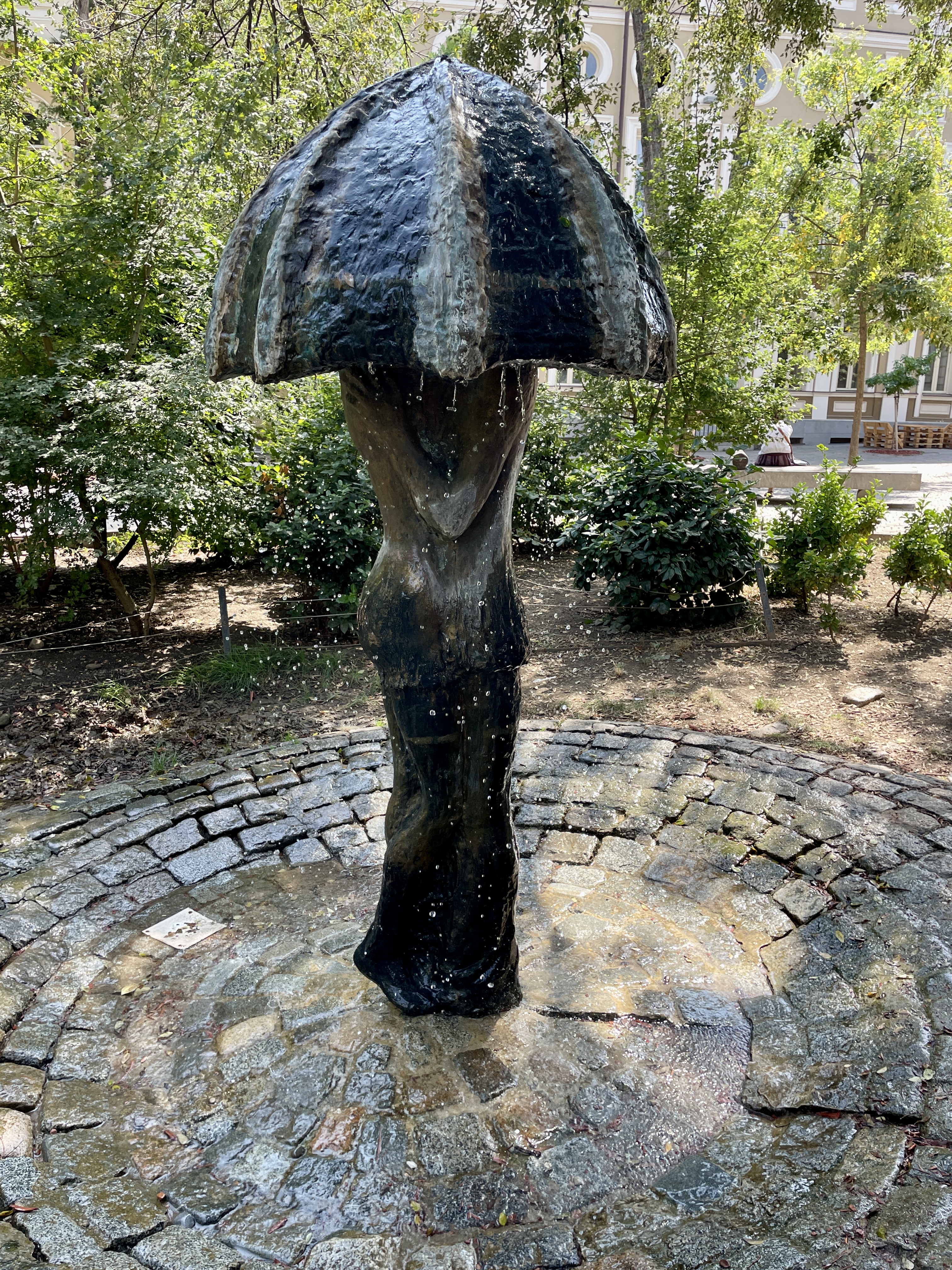
We found a quiet place, Gudiashvili Square, with just a few locals walking their dogs or sitting chatting. In the centre is a fountain made from a charming statue of two lovers under an umbrella.
From there our random walkabout led us to the Jvaris Mamas church. Unlike all th eother churches we visited, this one has had its frescoes restored, meaning that they are complete and in vivid colours, covering nearly all of the interior walls.
From there we returned to the baths district, which we’d seen with Lali on our first day. The baths are all fed from a hot spring which also feeds into a stream running down a steep and picturesque valley. In the end we decided just to sit and drink tea watching the valley and the people in it, rather than trying to take a bath. Thanks to the online bus map and guide, I was able to find a bus which took us from there straight back to our hotel.
One very striking thing everywhere in Georgia is the presence of vending machines in the street, selling beer, soft drinks, snacks and so on. The only other place we’ve seen this is in famously crime-free Japan. In France, Britain or the US they would be vandalised and robbed within hours. It tells you a lot about Georgia. During our strolls around Tbilisi, sometimes in narrow, deserted streets, we never felt in any danger.
As we walked the short distance from the bus to our hotel, we passed what seemed to be a combined hotel and up-market shopping mall. We went in to explore, and found a huge courtyard full of people, mostly students. Following the example of someone emerging from a side door, we found a wine bar run, improbably, by a Dane. We spent a very pleasant half hour sitting on the terraced staircase in the cool evening air. Apparently the place used to be a huge printing works, in Soviet times, which has now become a hotel, and art gallery, and some wine bars and restaurants.
For our last dinner we wanted something a bit different from the standard classic Georgian food we’d eaten all week. But we still wanted something with a Georgian touch - it seems silly to visit Georgia to eat pizza or sushi, even though these were readily available. We found a highly-rated restaurant called Shavi Lomi, billed as Georgian/European fusion. Our first impression was not great. We took a Bolt to get there, since the bus ride, though possible, looked a bit adventurous. At first we went along busy streets lined with shops and restaurants, on the north side of the river. But then we turned into a series of deserted back alleys, and in the middle of one the car stopped and the driver made it clear we were there. We saw the sign for the restaurant, but a heavy steel door was firmly closed and locked. Just as we were wondering what to do next, the door opened and a very apologetic woman beckoned us inside. The transition from the deserted, dirty street to the busy, well-lit courtyard was a bit Tardis-like.
The food was excellent. I had a beef stew and Isabelle had a lamb dish. We decided to drink a “white” wine with this, an amber Kisi qvevri wine. It sounds improbable, but they went perfectly together. It made a pleasant complement to all the classic food we had eaten.
|
|
 | |  | The Romantic Fountain,
Gudiashvili Square |  | | Restored Frescoes, Jvaris Mamas |
|
Return
The next morning, it was time to return. Many years ago we boarded an Air France flight in St Petersburg, with great of relief that we had survived and even enjoyed our week in Russia. We had no such feeling this time. I would happily go back to Georgia any time, and there is still a lot we have to discover - the high mountains of the Caucasus, the Black Sea coast at Batumi, and no doubt others too.
Air France did nothing to make us feel welcome. The crew was interested only in hiding in the galley, and the food was truly awful - such a shame when you consider what Georgia is capable of producing.