Monday, 1 February 2016

Offroad in Anza Borrego: Getting There

We've been to the Anza Borrego park a couple of times before, but we never had a proper 4x4 so there was a lot we couldn't explore. This time we drove there in our Toyota FJ, giving us the ability to go absolutely anywhere legal.

To make the journey there more interesting, we decided to repeat our journey of a few years back along the San Andreas fault. You can stay within a few miles of the fault all the way to New Cuyama on route 166.  The route is 200 miles long from Hollister to New Cuyama, and there is no gas anywhere along it. I was glad to have an extra 5 gallons of the stuff in the can on FJ's roof.


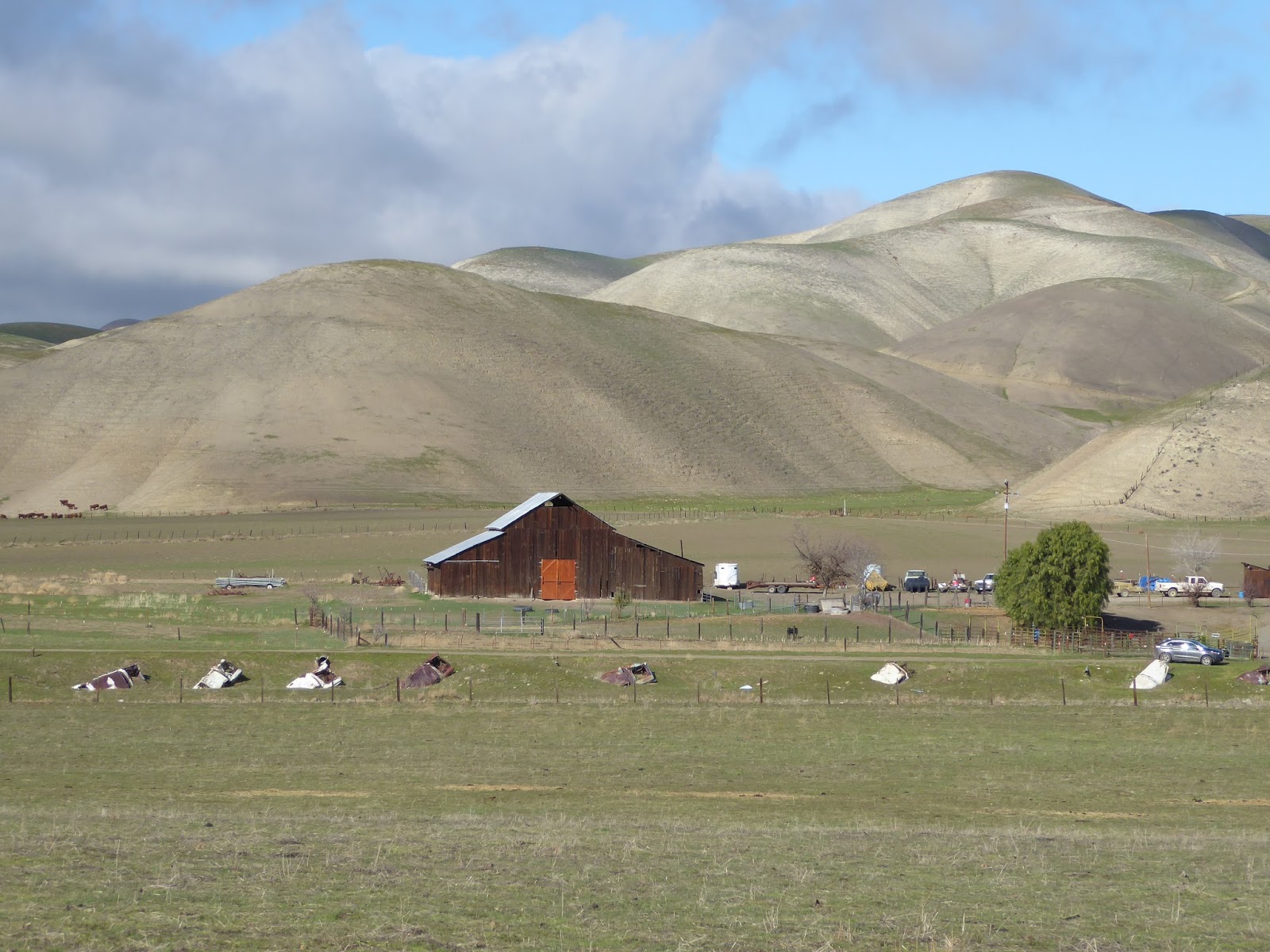
The first part of the route passes along the eastern edge of the Pinnacles, on route 25, a beautiful road with almost no traffic. One oddity: towards the southern end it crosses a river, and along the river bank there are a dozen or so 1950s cars buried, nose first. Why? I couldn't find anything about this on the web, so short of going and knocking on the door of the farm house, there's no way to find out.

After that you have to deviate from the fault for a while - there used to be a road that ran along it, but no more. This takes you over the Parkfield Grade, a steep and twisty road whose last few miles are dirt. It's easy when it's dry, but it was muddy this time and I was very glad
we had FJ.

Parkfield is a very strange place. It's right on the fault, and there's an earthquake research center there. There's also a cafe, where we hoped to get a hot drink, but it was closed for renovations. There's a hotel, too, very rustic with a huge fireplace, everything made from great logs, and a collection of books to read to while away the evenings going back to the 1950s.

Since we couldn't get anything to drink in Parkfield, we stopped at the restaurant by the James Dean Memorial on route 46. This was the only open place of any kind along the entire route. They do a mean fruit pie! Where the employees live, I have no idea - the nearest town is Paso Robles, over 20 miles away.

We last drove this route about ten years ago. There used to be a closed, boarded up general store in the middle of nowhere between route 46 and route 58, but this time there was nothing left of it except a patch of bare earth. How on earth did the store ever make a living from the occasional ranch in this desolate countryside?

A few miles more brought us to the Carrizo Plain, with its giant 250 megawatt solar energy plant. Further on is dried-up lake bed. This is very visible from the air, even from an airliner at 30,000 feet. The day's weather was strange, with a dark overcast and occasional showers, and very cold too. It's an incredibly desolate place, made even more moonscape-like and spooky by the unusual late afternoon light.  In the middle of the most desolate stretch of all, we came upon two cars full of kids blocking the road. Just as I wondering how to deal with this, one of them backed up, leaving a gap. What they were up to, we had no idea - maybe a drug deal? But the nearest town of any size is over 50 miles away.

As we finally reached a proper road again, it started to snow. That was really a surprise. We were very glad to get to New Cuyama. It's not much of a place, but it's the only settlement of any kind for 30 miles one way and 50 the other. And it has a gas station! - although when we arrived, only one pump was working.

There's also a hotel and restaurant, the Buckhorn. There's even an airport, or at least a runway - it closed a few years ago, but the new owners, who also refurbished the hotel, reopened the runway. I guess it makes a good $100 hamburger destination for people in LA. We spent a pleasant evening there, with a giant burger for dinner accompanied by an excellent margarita, finished by watching some local guys play pool.

Friday, 16 October 2015

Flying the Bay Tour

A friend of mine asked me the other day for tips about flying a Bay Tour - an aerial tour of San Francisco and the surrounding area. I've done it so many times that it's routine, including all the things ATC can do to make it more challenging. But it's true that if you've never done it, it's pretty daunting. I was lucky since, flying out of Palo Alto as a student and ever since, I got to practice it all with my instructor. There are some articles on the web about it, but they all seem to leave out some of the wrinkles you may need.

First, what is a Bay Tour? There is no "official" definition. If you tell Norcal you want a Bay Tour, they'll assume you're going to fly from wherever you are to downtown San Francisco, taking in the Golden Gate bridge and Alcatraz somehow along the way, then loop back in the same general direction as where you came from. There are no official routes (except generally-used transitions through the SFO Class B).

You can fly over downtown San Francisco and the Golden Gate without talking to anyone, but that doesn't make it a good idea. For one thing there is often a lot of traffic, especially if it's a nice day. And you'll be a bit constrained as to what you do afterwards. You can certainly do it without transitioning the SFO Class B, if that makes you uncomfortable, by crossing the bay and transitioning Oakland instead.

Starting from Palo Alto, I like to fly across the hills to the coast and fly up towards and over Half Moon Bay, before crossing the bridge, looping round Alcatraz, fly over the city then transition past SFO and back home. If the light is especially pretty, I'll do a loop around the bridge, Sausalito and the Marin headlands, and maybe another over the city. That takes 50 minutes or so and has been much appreciated by many, many visitors and friends.

Alternatively, it's possible to do the SFO transition outbound, or even both ways. If the coast is socked in, this is the best way. I'll talk about both.

There's nothing scary about the Class B transition, but you need to have a good radio technique. If you sound hesitant or the controller feels there's any risk that you won't do as you're told, all you get is "remain clear of Class Bravo." You'll be mixing it with airliner traffic at one of the busier airports in the country, in a very complex airspace. The last thing anyone wants is to have to divert a jet with 500 people on it, just because some Cessna driver gets confused. A few years ago there was a conflict between a departing 747 and a Bay Tour, which made it into the newspapers. There was never any danger, but not surprisingly it has made the SFO controllers a lot more careful.

Before you even get to the airport, you'll want to check the weather. It's best on a perfectly clear, cloud-free day, but you can't count on that, especially if you have visitors who aren't here for long, so you may need to compromise. If the ceiling is anything above 4000, you can do everything described here, though the pictures won't be as pretty. Often there's an overcast along the coast. The city of San Francisco is notorious for its micro-climates, so you can have heavy overcast at the coast, yet brilliant sunshine a mile inland. Webcams can be helpful in planning all this.

So... let's suppose you're taking off from PAO, or arriving from somewhere further south, and you want to fly the "Bayshore transition" northbound towards the city. From PAO, you'll ask for a "straight out departure for Bay Tour". They may come back and say "SFO is not accepting transitions at this time." In that case there's another technique, which I'll come to later. But let's suppose they are OK with it.

On takeoff, you'll fly just to the west of 101 (aka the Bayshore Freeway, though I don't think anyone who isn't in ATC has called it that for decades). You'll fly at 1500 feet or so, and get handed off to San Carlos tower (119.0). They in turn will hand you off to SFO tower (120.5), and direct you to remain clear of Class B. That's a tricky bit, because you don't have much time to get a word in edgeways with them and get clearance into Class B. You have to be prepared to do 360s in the fairly narrow space between SQL's airspace and the to-ground part of the Class B, while trying to talk to SFO tower. Visually, the latter starts just beyond the San Mateo bridge, so it's easy to stay clear.

Eventually, you'll hear the magic words "cleared into Class Bravo", along with an altitude (usually 1500 or 2000) and "remain south and west of the Bayshore Freeway". Now you can potter northwards while your passengers gasp with amazement as you pass almost within touching distance of the 777s and 380s on the ground.

The normal runway usage at SFO is 1L/R for takeoff, and 28L/R for landing. There is no conflict with this. However really heavy planes (i.e. those going to Asia and Europe) use 28L/R for takeoff. If one of these departures is happening, you'll either be told to remain clear, i.e. to continue to fly circles just before the bridge, or given some kind of hold, typically a left 360. Very occasionally, you may be directed to fly mid-field over the airport - which is pretty amazing to do.

Once you're well clear of the 28 runways, you'll be told "own nav" and handed off to Norcal (135.1). There can be a lot of traffic over the city - tourists like yourself as well as sightseeing flights including the helicopter and a seaplane which operates out of Moss Beach. Norcal will call traffic but they may not be talking to everyone so you need to be really eagle-eyed.

It's up to you what you do now. I generally fly at 2000, which gives me an out at least to get to water if the engine stops. It also keeps you legal over the downtown area (remember, 1000 feet above the highest point within 2000 feet). You can fly a circle or two over downtown, head out around Alcatraz, then over to the Golden Gate bridge and maybe a circle there.

Now for the alternative. If you come from further south, you'll typically be higher (3500 or so) and talking to Norcal on 135.65, the SFO approach frequency. You'll never talk to SFO tower. If you get told "transition not available", then this is what you need to do. So you ask PAO for a left Dumbarton departure with handoff to Norcal. Then, when you get handed off to 135.65, you ask for a Bayshore transition at 3500. Generally (I've never been refused in decent VFR conditions) they will clear you into Class Bravo and "climb and maintain 3500". They may tell you to fly over 280 rather than 101 - the difference is only a couple of miles. The advantage of being this high is that there is no possible conflict with departing airliners.

As I mentioned, I prefer to fly over to the coast and overhead Half Moon Bay. For this you need to be on the KHAF CTAF (122.8). Unfortunately that frequency is shared with Watsonville and several other nearby airports, so it can get busy and squeally. Fly overhead KHAF at 1500, self-announcing and keeping a very careful eye out for arriving and departing traffic. You could go higher, but you'll need to be below 1500 feet in just a few miles, so there's no point.

It's common to have a layer of cloud over the ocean and sometimes over the coast. Often, the tops are so low that you can safely and legally just fly over it. If not, you should not use this route. Or if you decide to take a look and see, be prepared to turn around and head back overhead 92 towards San Carlos, give them a call (119.0), and then proceed as described above.

If you look at the SFO Terminal chart (and you had better study it pretty carefully), you'll see that there's a tiny segment carved out of the SFO surface zone off the coast at Pacifca, with a 1500 foot floor. This is so you can stay close to the coast while the notoriously under-powered Convair 440s take off from 28 at SFO. No, there haven't been any of those for several decades, but nobody has told the airspace designers. Modern jets are already comfortably at 3000 feet by the time they cross the coast. But anyway you have to stay below 1500 - I generally go for 1300 to be on the safe side.

As you fly into this sliver of airspace, call Norcal on 135.1. This goes something like "Norcal approach, Cessna 12345 entering the Pacifica transition at 1400 for Bay Tour and return to Palo Alto." They will give you a squawk and say something like "remain clear of Class B, notify when you are ready to return to Palo Alto."

You can do the whole thing at 1500 feet, but once clear of the Pacifica transition I prefer to climb to 2000, once again to stay for-sure legal and to give me better engine-out options. Flying over the Golden Gate bridge is a sure-fire passenger pleaser, and quite often I'll loop around to the left over Sausalito and back round over the Marin Headlands, to give them (and me) a second chance for the pictures. Once again, keep a very careful eye out for traffic. If it's a nice day (and why would you be doing this otherwise), there will be plenty.

Eventually, you'll want to return. Stay tuned to 135.1 the whole time, but don't call anyone until you've finished flying in circles and ready to head straight back. Then call Norcal and say "request Bayshore transition for return to Palo Alto [or wherever]". Usually they will clear you into Class B and hand you off to SFO tower (120.5). If they refuse, it's time, again, to request a transition at 3500. As long as there are no clouds, this will just about always be granted. They'll clear you into Class B and climb you to 3500 or 4000.

This can always be complicated by heavy departures from SFO 28. Sometimes, SFO tower will have you fly circles over the stadium at Candlestick Park (currently - stadiums change owners fairly frequently), or right 360s just before San Bruno mountain. If you're at 3500 you may get heading changes to keep clear of this traffic. It's always very impressive to have a 747 or, lately, an Airbus 380 taking off practically across your nose.

Whichever altitude you choose, you'll be told to stay south and west of the Bayshore Freeway (maybe overhead 280 if you're higher). You potter down past the airport, watching the heavies come in from Asia and Europe and counting the 380s on the ground. Once you're getting close to the San Mateo bridge, you'll be handed off to San Carlos (if low) or 135.65 (if high). And then the excitement is over.

An alternative route is to cross the Bay, staying north of the Bay Bridge, and then transition overhead Oakland. Sometimes you'll be given this, though it's always worth asking about the 3500 foot transition. In this case you'll start by talking to Oakland north tower, then handed off to south tower (the airliner part of what is really two separate airports that share only a name). They'll take you overhead the 30 numbers at 2000, before descending to 1400 to fly down the Bay staying well clear of SFO's Class B.

I've flown this route, or variants of it, over 50 times, and it is always a pleasure, and always a little different. And that's not to mention the few times I did it in the helicopter, overhead the city at 1000 feet and 50 knots and even once under the Golden Gate bridge, which believe it or not is perfectly legal in a helicopter.

Sunday, 2 August 2015

The Garden Railway: Ruby the Live Steam Engine

In anticipation of my grandson's visit, I thought it would be fun to add live steam to the collection of motive power for the garden railway. You can spend a lot of money on live steamers, but that wasn't what I was looking for. The Accucraft Ruby is a little 0-4-0, a "proper" steam engine with real valve gear, and affordable. I found one on eBay and a few days later, it showed up, very pretty in its bright red paint. It wasn't covered in oil, and didn't bear the scars of high-speed derailments, so I'd say it had never been run.

I should start with an executive summary of the garden railway live steam experience. It doesn't last long, it's completely unpredictable. It is certain that you will get painful burns. It's fun, and my grandson loved it. It is absolutely not to be confused with running a railway, even a model one.

First, though, there are supplies to be obtained. Distilled water and butane are available at True Value (the ubiquitous hardware store), no problem there. But steam oil (needed for the cylinder lubrication)... not so obvious. Probably any heavy oil would do, but to be safe I ordered some from Accucraft. Their minimum order is four half-pint bottles. The engine uses less than one cc per run. I have enough to last for about 500 years.

Getting the engine running is pretty easy. Plenty of 3-in-1 oil on all the moving parts (no risk of over-lubrication here), fill the butane tank, top up the lubricator, and put 80cc of water in the boiler. This needs a tiny funnel to fit the ~5/16" (8mm) hole. Then put it on the track and light the burner. So far, no excitement.

It takes about five minutes for the boiler pressure to reach the 30 psi working pressure, once I got the hang of setting the burner valve. Then the excitement begins.

Before the engine will run, the cylinders have to be "primed". This means getting them hot enough that the steam doesn't condense, and the only way to do that is to pass steam through them until it stops condensing. The technique is simple, if spectacular. Put the engine into forward gear and push it along the track, turning the wheels. A fountain of near-boiling oily water shoots a couple of feet into the air, covering everything in the vicinity in a painfully hot shower. Never do this wearing clothes you care about! Once the water evaporates, the oil stains are permanent.

Then you drag the loco backwards lightly, without turning the wheels, and repeat until the fountain of hot water is replaced by a jet of soggy steam. Now, you're ready to see some live steam action!

The regulator (the valve that controls the flow of steam to the cylinders) rotates through about 180 degrees. But practically speaking, it has two settings: stopped and supersonic. There's maybe one degree of movement between them. Oh, and a substantial delay between opening and it and seeing the effect.

Sooo... you open the regulator very slowly until, with a gentle push, Ruby just begins moving on her own. Very slowly she chuffs down the track. It's immensely satisfying. The instructions say she should never be run faster than a scale walking pace - say a few inches per second, and that's exactly what she is doing. Until she is just out of reach... when a steam-age miracle occurs and she switches to supersonic mode. Traveling at something like a scale hundred mph, she corners amazingly well on the four-foot radius curves of my main line, disappearing rapidly down the long straight parallel to the pool.

But it can't last, and on the next curve or the one after she flies off the track, landing on her side. If you've managed to get this far without sustaining second-degree burns, you certainly will now. Steam, boiling water and burning butane are spewing in all directions, and everything you can touch is burning hot. Ignoring everything, she has to be picked up by her wooden buffer beams - the only part that won't deliver instant burns - and restored to the track. If she falls on her left-side, the butane valve has probably closed as well, since it sticks out to the left when open. This means opening the near-red-hot smokebox door (I still have the scar on my thumb) to relight the burner.

Out of five runs, I did just once get her to tour the whole railway and keep going without ever derailing. She was still going way faster than the instructions say (I think they are just a tease), but she managed to stay on the track. She lasted for about five minutes before the butane tank emptied, puffing along slower and slower on her small reserve of steam.

She has simple pin-and-link couplings, incompatible with any rolling stock I own. But it doesn't matter, because there really wouldn't be much point in giving her a train - it would just be more to fly off on the corners, and to rerail afterwards.

She has little metal footsteps on each corner. I don't understand why, but just one of these bends every time she derails, so it fouls the track. And of course it's burning hot, and you can't get any purchase anywhere else to straighten it out. The solution was to remove it. Her pretty red paint is scratched and scraped on every corner, from her frequent derailments, and she is covered in a thin film of the oil that she sprays everywhere as she runs.

So that was our live steam experience. Zac loved it, but now that he has returned home, I doubt that Ruby will be getting another outing for a while. It was fun while it lasted. And it has certainly removed any temptation to spring $2500 for a live steam scale model of a Shay.

Monday, 25 May 2015

The Garden Railway and WiFi for the Arduino

The railway has taken a back seat for the last few months, thanks to a hectic period at work as we tried (successfully, we think anyway) to find more funding, not to mention lots of work on the product.

But with Zac's visit only a couple of months away, it was time to get everything working again and even try to make some progress on the automation.

No trains had run for several months, and the rails were filthy both with black oxidization and with general garden gunk. Mr Bouncy, the LGB track cleaner, made a valiant effort but even so the trains wouldn't run smoothly. I gave up and went round the track with a hand sander, which got everything nice and shiny.

Foolishly, I'd left all the electronics outside over the winter, protected from rain and sun but still exposed. But after a few problems it all came back to life again, and the trains were running.

The plan has always been to automate the railway, so all the trains run in turn under computer control. There's already a little automation, to control the reverse loops at either end of the line. That is done strictly with a couple of boxes full of miniature relays. While it's always fun to figure out how to do things this way (ever since I read how the Post Office built the telephone network), running several trains is beyond what's reasonable.

My original idea had been to do everything with one or more Arduinos, with train detectors connected to the inputs and motor shields to operate the LGB point motors. An RS-232 connection to the NCE controller would control the trains. For a simple fixed-function controller this can easily be done. But figuring out the NCE commands from the limited documentation was a real pain.

That was when I thought, JMRI has already done this. It's a comprehensive framework for building control panels, operating all the different DCC control systems, and a bunch of other things too. It allows control scripts to be written in Python (well, actually the Jython dialect, but for most purposes they're the same).

But that means getting train detector information back to JMRI. DCC is superb for controlling trains and accessories, but its great weakness is that it has no way to feed information back. NCE has a proprietary way to do it, but it means running separate wires which kind of defeats the object.

The Arduino is a good way to collect data from a bunch of sensors, but somehow it has to get back to the controller. WiFi seems obvious, but when I started this WiFi shields cost several times more than the Arduino itself. JMRI supports an RS-485 two-wire based protocol called CMRI, and that looked promising. I bought the necessary parts but programming it seemed tricky so it didn't get very far.

By the time I picked up this project again, you could get Arduino WiFi shields based on the TI CC3000 chip for $11.95 on Ebay - Chinese ripoffs of the Adafruit card, which use the same software library. The CC3000 has a complete TCP/IP stack on a chip, as well as the WiFi hardware. This is really the ideal solution, especially for remote locations like the far-end reversing loop.

But when I tried to connect it, nothing happened. I have two WiFi systems at home, one running the old security standard WEP and the other the newer one, WPA. After some messing around - the WEP password has to be presented explicitly as a series of hex bytes - I got the actual WiFi connection to work. But no further. For some reason it would not use DHCP to connect to the router itself.

I took the setup to work the next day. With the WPA2 network there, everything worked fine and the example program did exactly what it should. So at least I knew that the hardware and library worked. But back home, nothing. Running Wireshark showed that the Arduino never transmitted a DHCP request. The only difference between the two networks was WEP versus WPA.

Eventually I convinced it to connect to my other network - the trick is to tell the CC3000 that it's WPA2, even though it is actually WPA. And then - it's a miracle! - DHCP got an address, and my test program worked. Conclusion: the CC3000 doesn't work with WEP. It manages to connect, but probably it gets something wrong in the encryption of data packets, so they can't be read correctly.

Along the way I realised that for the sensor input, JMRI was just getting in the way. My intent had been to use its JSON facility to communicate sensor information, which in turn can be interrogated by the script. But a much better way is to use JSON to control the trains, using JMRI just as a translator to NCE-speak. That way my Python code can run as a standalone program, receiving input from the Arduino(s) directly.

So now, the Arduino sends a UDP message to a well-known broadcast address every second, or whenever a sensor changes, with the current state of all the sensors. I found a nice webpage which explains how to listen for multicast messages from Python.

Now I just need to finish the rest of the code and install the sensors, and I'll have an automatic railway at last. If only the trains would stay on the track - but that's another story.

Update 5/25/2015

Well, I spoke too soon. The CC3000 board I'm using is a reliability disaster. It worked kind-of OK for a while. Then for a while it wouldn't execute DHCP correctly, getting stuck halfway through the message exchange (never sending a Request). Now today it does DHCP OK but resets the whole Arduino when connectUDP is called. It looks as though the chip itself is a Chinese ripoff as well as the board - there is no TI logo on it. I've ordered a "real" one from Adafruit, at nearly four times the cost. I hope that works. I've tried with and without external power, so that isn't the problem.

Update 6/3/2015

The Adafruit CC3000 shield did indeed fix most of the problems. DHCP works reliably at least some of the time. It still isn't perfect though - it often takes a board reset before it will work, and sometimes a power cycle. I'm not sure how this is going to work out for my garden railway application.

The resets were due, I eventually realised, to not having enough data memory. There is only 2K bytes, and if there isn't enough, the stack collides on its way down with the static data, resulting in mayhem. I put the static data structures on a diet and the problem has gone away.

Update 6/4/2015

OK, I give up. The Adafruit shield was better than the Chinese one, but nowhere good enough to be usable. It comes up maybe one time in four. The WiFi and DHCP exchange generally look OK with Wireshark, but the microcode mostly doesn't get to the point where you can send messages successfully.

Just bought a 25 foot USB cable... not as elegant or convenient, but there's a limit to how much time I'm willing to spend on what is obviously a very broken piece of silicon (or software for it).

Tuesday, 3 February 2015

On LinkedIn Invitations

I'm not particularly well known, but I've been in fairly visible positions in companies large and small for most of my career, so inevitably I get "invitations" on LinkedIn pretty regularly.

I'm pretty liberal about accepting these - after all LinkedIn is all about maintaining a sound professional network. Anyone I've ever worked with, or even who I could have worked with but maybe never got to know, is fine. It's not like Facebook, which I limit to real-life friends and acquaintances - maybe I haven't seen them in a very long while, but at some point I could have gone for a beer or a coffee with them, and I still would happily if the opportunity arose.

But actually most of these "invitations" come from people who not only I've never heard of, but even after I look at their profile I have no idea why they've suddenly decided to get in touch with me. Maybe they think I might give them a job or put some work their way, maybe they have some other reason.

Yet they invariably come with the default LinkedIn text "I'd like to connect with you on LinkedIn". I'm sure you would, otherwise you wouldn't have sent me an invite, but why? Wouldn't it be nice to take the time to say, "I see you were at XXX a few years ago and so was I, right now I'm looking around for a new opportunity and I thought you might be able to help".

Or, "My company makes widgetators and from your role, it looks as though you might sometimes need them."

Or, "I'm a recruiter and I like to have thousands of people in my LinkedIn contact list even though you'll probably never hear from me." (I get quite a few of those, if you have "recruiter" in your title or role you can reasonably presume that I will not accept your invite unless I know you personally).

Or even, "You have no idea who I am and to be honest I have no idea who you are either, but I like to have a huge list of contacts and I pulled your name from a hat today so I thought I'd send you this invite".

Sending the default invite text is not only lazy and impolite, it's also self defeating. If I've never heard of you and you give me absolutely no reason why you want me to add you to my contact list, what on earth makes you think I'm going to accept it?

Monday, 22 December 2014

Driving in Japan


Japan has by far the best public transport system in the world. Major cities are linked by 200 mph trains, every large town has a frequent rail service, and even the tiniest town has several buses a day to the nearest station. Every city has a dense and frequent bus service, while in Tokyo you're never more than a five minute walk from the train or subway. Japanese trains are a delight to ride, with constantly changing views of the towns and countryside. With the exception of the Tokaido Shinkansen between Tokyo and Osaka, they are rarely anywhere near full.

So given all that, why would you ever want to drive? The traffic in towns is difficult, parking is expensive and hard to find, while navigation, if you don't read at least some Japanese, is bound to be hard.

But... if you want to see the countryside, to stop at leisure to admire the view, to wander at will - you need a car as much in Japan as you do anywhere else. It's possible to view rural Japan from a bus, I've done it a couple of times. It works, but it is very constraining. When we visited Wakkanai in the far north of Hokkaido, we couldn't rent a car (I'd forgotten my international driving license, which is essential). We did manage to get to Cape Soya, Japan's northernmost point, using the bus, but we had a very tight timetable and didn't have time to see all the various monuments that have been established there.

Practicalities

Car ownership is relatively uncommon in Japan. You can't legally own a car unless you have off-road parking for it. That's why there are so many really tiny cars - often you will see them squeezed into a garage so small that you wonder how the driver gets in and out.

As a consequence, car rental is ubiquitous. Close to the main station in every town, you'll find Toyota Rent-a-Car, Nissan, Nippon, Times, and a couple of others. It's taken for granted that people will use the train for the long journey, and a car only for the very final part.

But you didn't see any of the familiar names there: Avis, Hertz, Enterprise... You can make reservations through them, but they will be fulfilled by Japanese companies with different names. For example, I recently used Expedia, which made me a reservation through Europcar - but I actually had to go to Times Car Rental, and nothing in the reservation told me that, nor gave me their correct address.

It's better to book directly with a Japanese company. If you have a few days in Japan before you need the car, your hotel concierge desk will generally be able to do this. Some companies have english-language sites (e.g. http://www.timescar-rental.com), and there is a site called ToCoo! you can use.

The Japanese drive small cars. This is a good idea, because the roads are narrow, city streets sometimes frighteningly so, and parking spaces are small too. A "mid-size" car in Japan would be one of the smallest cars on the road in the US. Don't try to get a normal-sized car by US standards, it will cost a fortune and you won't be able to park it.

You can not rely on your own driving license. Japan is a country which absolutely requires an International Drivers Permit (IDP). If you don't have one, when you show up they will apologise a lot but they won't give you a car. In most countries these are available through motorist organisations such as AAA (US) and RAC (UK). For some countries, including France, the procedure is different, and you need an official translation of your license instead.

The pick-up procedure is generally painless. You find the office (usually the hardest part), you present your passport and IDP, and they show you to a car. Make a careful note of where you are, because you will have to find it again when you return the car. Drop-off is also painless, apart from finding the place, and assuming you haven't damaged the car. Most places have little experience renting to foreigners, and they are very relieved to see you back again. I once dropped off a car a few minutes before closing in a small town, and the staff were standing at the roadside waiting for me!

If possible, get a map from somewhere (for example, your hotel concierge) showing the exact location of the rental office. Otherwise, you may well spend a miserable half hour wandering up and down the vicinity of the station looking for it. Also, be careful which side of the station it is. Most stations have entrances on either side of the tracks. Often rental places are on the "wrong side of the tracks", away from the main entrance.

Driving

Driving in Japan is easy. Speed limits are low - 50 km/h (30 mph) on most roads, only 80 km/h on highways. People sort-of obey them, as elsewhere - most traffic is doing closer to 60 than 50, but not more. Important signs are easy to understand. There are lots of signs that are only in Japanese, but they're not giving directions. They say things like "sharp curve 200m ahead" - useful but not indispensible.

Roads in Japan can be strange. It's the only country where two-lane divided highways are common. That's right, just one lane in each direction, with no possibility of overtaking. It matters less than you'd think, because the speed limits are so low and everyone is driving at the limit anyway.

The road around the western coast of Shikoku is sometimes barely two lanes wide, then for a few km it's a four-lane highway. It alternates like this for a long way. The giant refrigerated trucks carrying fish to market don't care, they just barrel along at 60 km/h whatever the state of the road.

In Hokkaido, we were following a road along the coast that got narrower and narrower, and eventually turned into a dirt track. We were just thinking about turning round, when in the middle of nowhere it turned into a four-lane highway - better than the main coast road running inland. There was no apparent reason, no factory or houses. I'm sure there's a story behind it.

The hardest part of your journey is likely to be getting out of, and later back into, the town where you rent the car. Signposting in towns is almost non-existent and roads are often not quite as they seem on the map. You should really prepare carefully for this. Print bilingual maps from Google, possibly at several different scales. Even if you don't know the exact location of the rental office, it will be somewhere close to the main train station.

It goes without saying that you should drive carefully and be sure to stay legal. Even if at home you sometimes interpret the rules a bit flexibly, don't do it in Japan. It's said that if ever there is an accident involving a non-Japanese driver, they will always be at fault. I hope I never find out whether it's true - I really don't want to spend a few nights in a Japanese jail. And nor do you.

And of course don't even think about drinking and driving. There's nothing to do and nowhere to go in the evening in rural Japan anyway.

Fuel

You will have to refuel the car at least once, just before you return it, and maybe more if you drive a long way. Fortunately, this is easy. Gas stations ('gasoreen stando') are ubiquitous. In towns they are often hidden in a space under a large building, with only the sign visible from any distance. The most common brand is Eneos, with a distinctive orange sign. Japanese for "fill 'er up" is 'mantan', but gestures work fine too. Most gas stations are fully staffed, you just sit in your car while eager young men run around filling it and cleaning the windshield.

Sometimes there are surprises. We once refuelled in the depths of rural Hokkaido, and were rewarded with not just one but half a dozen large boxes of Kleenex. In our tiny car they took up way too much room, but it seemed churlish to throw them away.

Navigation

Now we get to the hard part. Japan has really excellent maps. Mapple publish road atlases, one for each prefecture, at a scale of 30,000:1, with enlargements for towns. There's also a very useful series of folding maps at 120,000:1 (about 2 miles to the inch). These are all available for the whole country at big bookshops. You can often find the local ones even in convenience stores. But... they are only in Japanese.

The best bilingual map of Japan is "Japan: a bilingual atlas", at a scale of 260,000:1. That's enough to show all towns and significant roads, and it has enlargements for major towns. Used in conjunction with one of the bigger maps as a sort of translation guide, it will get you there.

Google maps is also bilingual. If you have a tablet and a reasonable deal on roaming, you can use that. Even if not, you can use it to prepare your trip and maybe print some of the more critical bits and take them with you.

Directional signs on roads are written in English characters as well as Japanese. As everywhere, they won't necessarily tell you about the place you want to go to, so you need to have an idea of the route and other places that might be in the right direction.

Every rental car has GPS, but not only are the maps all in Japanese, so are all the controls. I do read Japanese, but I've still never managed to get anything very useful out of them. On one occasion the GPS had been programmed to go back home. At every junction and turning, a cute Japanese girl voice would plead with me to make a U-turn. It took me about an hour to find the right place to press to shut it up.

The GPS can be useful in towns. While I really strongly recommend against driving in towns, at some point you'll have to get to and from the rental location. Even though you can't read the map, you can get a general orientation get yourself headed in approximately the right direction. These days, they show gas stations too, which can be handy (look for the tiny Eneos logo).

Conclusion

If you really want to explore the Japanese countryside, a rental car is the only way to do it. It's a bit daunting, but not too hard.

Here is another useful link with some more information: http://www.japan-guide.com/e/e2022.html

Wednesday, 17 December 2014

Japan - the Sunny South

Well, not really the South, but at least not the North. And certainly sunny. Isabelle had another meeting in Sapporo. Wakkanai was interesting but Hokkaido's charms in December have their limits. So we decided to spend a couple of days on the Izu Peninsula, just south of Tokyo. In Japan, it's a famous tourist destination - with justification, since it is beautiful. We drove round it in one day, a few years ago, but this time we would take our time, spending a couple of nights in traditional Japanese ryokans.

Every trip to Japan starts with Tokyo. Using BA miles, the only seat I could get was in Japan Airlines First Class. Poor me. It was very nice. The champagne they served was Salon 2002. I'd heard of it only because, believe it or not, Isabelle sat next to Mr Salon (not his real name of course) on a flight to Paris a few months ago! It sells for about $300. Its main claim to fame seems to be exclusivity - any footballer can buy Dom Perignon or Krug, but you have to know about this stuff. I can report, though, that it is indeed excellent, very complex without the biscuity heaviness of Krug.

The rest of the flight was excellent, too. I slept through most of it, thanks to the comfort of the wide, lay-flat seat. The service is everything you'd expect. And there was a quite unexpected bonus. Our flight was nearly an hour early. It's scheduled to be one of the first flights into Haneda (oh, that's another nice thing - it doesn't go to Narita, the world's most inconvenient airport), leaving San Francisco just after midnight and arriving just after 5 am. So we were the first flight into Haneda that day, and since I was in seat 1A, I was the first person off the plane. I was the very first passenger to set foot in Haneda that day! Considering that nearly 200,000 people use it every day (it's the 4th busiest airport in the world), I found that pretty amazing.

Arriving early wasn't without problems, though. Connections from Haneda into Tokyo are excellent. The monorail service finishes within a short walk of our hotel. But it was nearly an hour before the first train. I decided to take a taxi.

Nearly everything in Japan works perfectly. The trains are on time to within seconds, everywhere is safe and clean, the people are friendly and helpful. Taxi drivers, though, don't work quite so well. This one had never heard of my hotel, although it is quite big and has been open for decades (I know, because I stayed there on my first trip to Japan in 1982). He called for directions, but when we stopped it was in completely the wrong place. Eventually, after some discussion and another call, we made it. This was only the first of the trip's taxi adventures.

We'd decided to stay at the Shiba Park Hotel. It's convenient, but it was really a touch of nostalgia - when we used to travel to Japan together in the 1980s for meetings at the Japanese Institute of Standards, just opposite the Tokyo Tower, we stayed there. It is full of memories - the open area on the second floor where we stayed up drinking vending-machine beer until very late, that we called "Lois's Bar" after one of our colleagues; the long disappeared fast-food restaurant on the corner called "Rubbery Pancakes" (well, it could have been "Lovely", it's difficult to be sure in katakana). Nostalgia, though, isn't what it used to be. We found it all rather old and cramped, with a view over the roof of the building across the road, and decided to move to a much more modern place a few hundred yards away, with magnificent views over the Shiba Park, the Tokyo Tower, and Zozoji.

We spent the morning exploring the area. Zozoji is an enormous temple. It was once the personal temple of the Tokugawa family, who ruled much of Japan for a couple of centuries. It's still evidently an important place - in addition to the vast main temple and several smaller ones, there are also administrative office buildings. We also found a wonderful place for breakfast. It's called "Le Pain Quotidien" (Daily Bread) although you'd be broke if you ate there every day. The quality and variety of their bread is really extraordinary.

We went on a shopping trip to Ginza, but were diverted by an enormous antiques market. Isabelle bought far too many porcelain dishes for our limited amount of baggage. For lunch we happened upon a tiny noodle shop in a back street. Ginza is the biggest, chic-est, most expensive shopping area in the world, yet it still has room for places like this. It had maybe six little tables, the husband in the back cooking while his wife served. Pride of place in the entrance was their soba-machine, where long before lunchtime they make their own noodles from buckwheat flour.

After that we were exhausted, and decided to get a taxi back to the hotel. Even though there are two metro stations within a short walk from the hotel, they are both served by lines that seem to go nowhere useful. The Oedo line in particular, constructed at great expense in the 1990s, seems to have been carefully calculated to avoid anywhere at all that might be a useful destination. We found a taxi quickly and jumped in. The driver set off in the right direction but then ran out of zeal. Eventually he pulled off the road and started consulting atlases. I explained to him (in Japanese) exactly where the hotel is, but despite much head-nodding it clearly didn't help. Finally, in desperation, he passed me his Tokyo street atlas. Good job I can at least somewhat read Japanese.


Next morning, after another breakfast at Le Pain Quotidien, we set off for Izu, taking the Shinkansen to Mishima. In the process I accidentally discovered how to save nearly half an hour on the journey by taking a fast train that overtakes the one you have just missed, then changing onto the latter at an intermediate station.

Just as well, because at Mishima we ran into a problem I was fully expecting. I'd booked a rental car through Expedia, with Europcar. The problem is, none of the well-known western rental companies has a presence in Japan, and the reservation didn't give the name of the company that would actually rent us a car. And the address that the it did give, didn't correspond to a rental company. I went to the first place I saw. They sent me somewhere else. That wasn't right either. Luckily, all the rental outlets are always within a short walk of the station - how else would you get there? After walking up and down the street in front of Mishima station for a long while, I finally found the right place. After that it was plain sailing, and we headed for the eastern coast of Izu.

Izu is really an extraordinarily beautiful place. The coast is a ragged series of inlets in black volcanic rock, dotted with tiny pointed islands topped with clumps of trees. Inland is nothing but tree-covered mountains. It rains a lot, and the vegetation is correspondingly lush, while the ocean keeps temperatures nicely balmy. It's impossible to avoid the comparison with Italy's Amalfi Coast.

After exploring the coast, we arrived at our first ryokan, the Kanaya in Rendaiji, just north of southern Izu's main town, Shimoda. It's a very traditional, rather rustic place, all unpainted timber construction, famous for its bath, the Sennin-furo - literally, the thousand person bath. It is huge - I did the math and concluded that a thousand would be a tight squeeze, though probably doable if they were good friends. I'd sprained my ankle earlier, in a walk along the coast, and the bath made for some very welcome relief. Dinner was the usual delicious kaiseki, served in our room.

At 9, we went to bed (or actually futon). There is absolutely nothing else to do in most ryokans. Once, in Ibusuke, Kyushu - a famous seaside town, comparable to say Carmel or Torquay - we decided to go for a walk, look for the local night life. It took some persuasion to get our shoes back. We walked for about twenty minutes, saw absolutely nothing and nobody. When we returned the owner was still standing anxiously in the porch waiting for us. If we'd been much longer, I suspect he'd have called the police and gone through the "lost gaijin tourist" procedure.

My ankle problem led to an interesting adventure the next day, first to find the pharmacy and then to buy a walking stick and other bits and pieces. Everyone we asked gave different directions, but the village was so tiny that we found it in the end. The people there were extremely helpful, although the only stick they had was more suited to the bent-double old women you see in every Japanese village - a bit on the short side for me.

Shimoda's claim to fame is that it was the landing spot for Commodore Perry in 1853, on his mission to open up Japan to trade with the US. It was an amazingly brave mission - they set out with just seven ships. It's hard to see how they thought they could succeed, but they did. It helped that they had a new design of cannon shell, with which they told the Japanese they would destroy their cities. A taste of things to come, really. When they returned in 1854, Japan had agreed to practically all of their demands. This was the real start of Japan's reopening to the rest of the world. As a result - and odd as it seems - there is a statue and small park dedicated to him on the waterfront. It's a bit as though Calais had a statue of the Duke of Wellington.

From there we drove around the southern cape of Izu and up the western coast. There are no trains on this side, and as a direct consequence there are many fewer tourists, even though the coastline is even more spectacular. There are a handful of onsen hotels along the coast, but nothing like a similar area in Europe or the US - the Amalfi coast, in particular. The sea around Dogashima is dotted with tiny story-book pointy islands covered in little tufts of trees. It would have been good to take a boat trip, but we were running short of time.

The main town on this coast is Matsuzawa - population 5000, plus presumably quite a of of tourists at least in the season. We planned to stop there and get some lunch - a bowl of soba would be ideal. We looked everywhere in the town centre, to no avail. There was what looked a bit like a small restauarant, but it turned out to be an antique store. We asked the proprietor and his wife where we could get some lunch. If we'd asked them for directions to the Lost Treasure of the Incas, the reaction would scarcely have been different. Eventually after much "soo desu ne" they decided that there probably was one somewhere and have gave us directions in some general direction. But there was nowhere in sight. In fact we did eventually find a couple of tiny places, but by then we were fed up. Luckily there was a convenience store - there is no shortage of those even in the smallest places - so we bought some rice snacks and cookies, and ate them overlooking Dogashima.

We had a sudden and completely unexpected view of Fuji-san. Then it was time to head inland to our second ryokan, at Shuzenji. The Kikuya Ryokan is very different from our first night. It has been there a long time but was completely rebuilt a few years ago, so the buildings are modern. It's a truly high class place, with wonderful service. The bath was less spectacular than at Kanaya, but dinner was much more sophisticated. Unusually, it is served in a dining room, with discreet cubicles but (oh thank you!) conventional tables and chairs rather than half-kneeling on tatami.


Early to bed again, and to rise in time for a complicated day of travelling. First return the car in Mishima, a quick shinkansen journey to Shinagawa, the Keikyu line to Haneda, and an ANA flight to Sapporo. By the time we got to our hotel there, it was nearly time for the dinner associated with the meeting Isabelle was there for. Time to jump in a taxi.

The dinner was at the Sapporo Beer Garden, by far the biggest tourist site in the city. After the station it is probably the single most common destination for a taxi. And - yep, you guessed - our taxi driver couldn't find it. Our journey petered out in a dubious industrial area on the wrong side of the railroad tracks (literally). Then, after some discussion, he suddenly said "Ah, Sapporo Beer Garden, desu ne!" and off we shot to the right place, which was in the opposite direction.

To a first approximation, there is only one meal you can get in Sapporo: "Gengis Khan". It consists of thin slices of lamb, grilled at the table along with some chopped vegetables. It owes absolutely nothing to Japanese cuisine, being rather of Mongolian inspiration. Why Sapporo has adopted this as its city dish, I have no idea. It's kind of OK the first time, but after a while you can't help hankering for a nice plate of sashimi.

The next day was cold, grey, and alternately rainy and snowy, and gave absolutely no reason to go outdoors. Isabelle had her meeting, and I stayed in the hotel room and worked. Afterwards, back to the airport and another ANA 777 took us back to Haneda, and to our next hotel, in a brand new tower in Shimbashi.

Our room was on the 33rd floor, with magnificent views over Tokyo (including our previous hotel). Best yet, it was right over the railway tracks, with a fantastic view of no less than 12 parallel (or almost) tracks, including the Shinkansen to Osaka (ten high speed trains per direction every hour), the Yamanote line (Tokyo's equivalent of London's Circle Line, with a train every 90 seconds or so) and the monorail line to Haneda.  I don't think I ever looked out of the window and saw all of the tracks empty. It was common to see six or seven trains at the same time.

It's a five minute walk from Shimbashi station to the hotel. What's amazing is the number of different ways you can do it. The obvious way, at street level, is by far the least convenient, with long waits for traffic lights to cross the busy streets. There's an underground shopping mall which goes most of the way, and there's a series of elevated walkways. I don't think we found  them all. Or if you're feeling lazy, you can take a train - the little Yurikamome line has two stations barely a train-length apart, one at Shimbashi and one beside the hotel.

Japan, including Tokyo, is not a place you can "do". Apart from the magnificent temples of Kyoto, there are no real must-see tourist sights. Rather, it's a place to experience. And that's exactly what we did for the next two days. We had lunch at our favourite rotating sushi place in Shimbashi, we visited Tokyu Hands in Shibuya, the very best craft and hobby store in the whole world, by a long way. On Friday night we had a very enjoyable dinner with some of my old friends from Cisco. On Saturday we visited one of Tokyo's several samurai-era gardens, the Rikugi-en, and drank traditional tea-ceremony tea with traditional Japanese sweet rice-paste cakes. These days, that's as exotic to the Japanese as it is to us. In Tokyo now there is a western-style patisserie about every ten yards. Some are better than others - some are truly excellent, the best in the world - but one things they all have in common is calories. And sadly, this shows in the people you see around Tokyo. Twenty years ago, overweight Japanese were practically impossible to find. Now, especially women, they are quite commonplace. It isn't Mississippi, yet, but it's certainly heading in the wrong direction.

Before that, though, we had another huge surprise. Our old friend Fuji-san was clearly visible on the horizon, over 100 km away.

We also went back to Harajuku. A few years ago, this was famous for all the "cosplay" kids - girls (mostly) in all sorts of fancy dress. This time, though, the craze seems to have almost died out - a shame, because it was really colourful. The teenage shopping street, Takeshita Dori, is as crammed with people as ever, but they're all dressed in boringly normal clothes. I couldn't help thinking of Carnaby Street in London. Briefly, in 1968, this was the epicentre of the youth movement, the in place to be seen and to buy the latest fashions. By 1969 it had turned into a tourist trap, selling cheap imitations of 1968 fashion - and still, nearly 50 years later, it is exactly the same thing. Probably every first-time visitor to London goes there, and it absolutely isn't worth it.

Our flights home left after midnight, so we still had time for one more dinner. This time it was a reunion with some former colleagues of Isabelle's, another delightful meeting with old friends, in a little place near Shimbashi. And then, back to the hotel, and a short wait for the bus to Haneda. Once on the bus, I realised I'd left my Shimoda walking stick in the hotel - impossible not to see that as somehow symbolic.

And then, back home.