Showing posts with label helicopter. Show all posts

Monday, 2 May 2016

Flying the London Helicopter Routes

To small planes the whole of London, from Docklands in the east to beyond Heathrow in the west, is a no-go area. With Heathrow's airspace, and London City's, and restrictions over the centre of London, almost everything inside the M25, except for fringes to the north and south, is closed.

Helicopters, though, are a different story. Because of their ability to land engine-out in a very small space and without risking damage on the ground, they are permitted on a small number of carefully planned routes that provide an out along their entire length - mostly in open spaces, except for central London where it is the river. These routes allow you to fly all along the Thames, from Chiswick to Greenwich, as well as directly overhead Heathrow airport. Considering how protective the UK is, it is astonishing - but true - that you can fly over Heathrow in the tiniest of single-engine helicopters, the Robinson 22. But you can - there are even videos on Youtube.

I'd wanted to do this for a long time, and finally a trip to England provided the opportunity. I booked a Monday morning flight with EBG Helicopters at Redhill Aerodrome (EGKR), in one of their Robinson 44s, so my son could come along too. I'd previously flown there in their Guimbal Cabri G2 (G-ETWO - geddit?). That was a very interesting introduction to a new (to me) type, but we didn't go very far from the field.

I'd prepared for the flight by studying the helicopter route chart, available from Pooley's, and reading what I could find on the web, e.g. this. From the south, the most interesting routes are H9, which runs dead straight from the A3 to just south of Heathrow at Bedfont, and then north to the A40 at Northolt. That is followed by a stretch of H10, along the A40 then turning right onto the North Circular Road (A406) to the river. There is a lot of IFR - I Follow Roads (or Rivers) - involved in this. H10 joins up with H4 (via a short stretch of H3), snaking along above the Thames from Kew through the centre of London to the Isle of Dogs. South and east of there, you can do what you want, relatively speaking anyway. H7 provides an alternative route north from Redhill straight into H4 if you don't want to fly over Heathrow.

Over the weekend, the forecast was not good, and I was afraid I'd have to cancel. But the morning dawned with blue skies. It clouded over by the time of our flight but never worse than 2500 overcast, plenty for this trip.

The first challenge is finding the aerodrome. Redhill has to be the hardest to find in the whole world, despite being only a couple of miles from Gatwick and sandwiched in the corner of the M25 and the M23. I'd been there before so had a rough idea, but was still very grateful for the data roaming package on my phone as I followed a succession of single-track country lanes and narrow roads through housing estates.

Once you find it, Redhill is a very interesting place. It's home to many of London's helicopters, including the Surrey Police, an air ambulance, Sky's ENG ship, and a good selection of expensive-looking executive machines. It also has a couple of grass runways but I've never seen a fixed-wing operation there - I think the runways must be waterlogged a lot of the time.

Briefing for the flight was simple enough - no flight plan or other permission is required. A quick call to Heathrow's ATC confirmed that they were taking H9 transitions, and then we jumped into G-PAMY to start our adventure: me, my son Joe, and my instructor for the day. It would be crazy to try a flight like this for the first time without someone who has done it plenty of times before. I asked him to take care of the radio calls since there are plenty of unfamiliar visual reporting points, and I'm not 100% comfortable with the differences between UK and US radio practice.

After takeoff our first call, crossing the M25, was to Heathrow Special. This sounds an odd name, to me anyway. All non-airline flights in Heathrow's airspace are done under Special VFR (SVFR), which is essentially VFR flight under IFR-like control. I did this once before flying from White Waltham to Stapleford, though I never got anywhere close to the airport. Heathrow Special is a dedicated frequency for such flights. They cleared us as far as the Bedfont holding point, at "approved altitude".  Every segment has an approved maximum altitude on the chart, sometimes changing every couple of miles, and you are expected to have this information to hand.


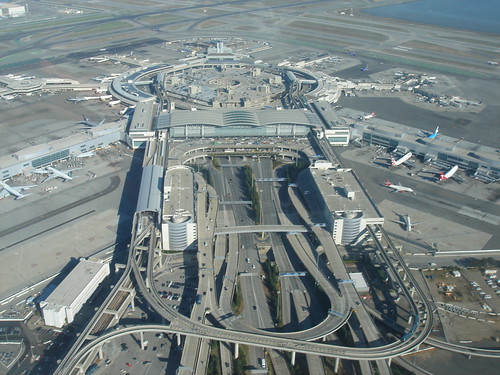
Close to Bedfont we were handed off to Heathrow Tower - a first for me and, unless I do this again one day, the only time. They were very friendly and helpful, despite handling the two busiest runways in the world as well as a pesky helicopter. There had been some concern about how long we'd have to hold, one of the guys at Redhill mentioned holding for 20 minutes and then again for 15 minutes between the runways. We had plenty of fuel and the view is excellent, so it wouldn't have been a problem, but it didn't happen. We were instructed to wait for one landing aircraft, which we did hovering at 1000 feet just south of the 27L runway numbers. Joe got several excellent shots of the arriving Air Canada 767. Once it was on the ground we were cleared to proceed across both runways, having hovered for less than a minute. The view was absolutely spectacular, along the whole length of Heathrow. I'm using to flying past San Francisco, and have even landed at LAX, but this was really extraordinary. There was a long line of departing aircraft, with a BA Airbus 380 at the tail. In fact I counted 5 A380s on the ground - a significant proportion of the entire fleet.

Once north of the airport, we went back to talking to Heathrow Special as we admired the collection of bizjets at Northolt - no evidence there that it is still owned and operated by the RAF. Soon we reached the Thames at Kew. The river is surprisingly twisty and quite hard to follow accurately, even though I slowed down to 60 knots - partly for manoeuvrability but mainly to enjoy the view. And the view was fabulous. With Battersea heliport below to our right we could see right across London, with Chelsea and the Royal Albert Hall off to our left. (At home we joke that Albert is plane spotting from his memorial, writing down the tail numbers of the airliners on long final into Heathrow in his royal notebook - this was probably the first time he logged G-PAMY).


Further on we got a very special treat - our timing coincided exactly with the Changing of the Guard at Buckingham Palace, giving us a spectacle of the Household Cavalry as well as the massed tourists in front of the palace. From the same location we also got an excellent view of the Houses of Parliament, Big Ben, Westminster Abbey and then Whitehall and Downing Street. I once had the good fortune to attend a meeting inside No 10 (the Cabinet Room, no less, though the occasion was much less exotic), but I'd certainly never seen it from this angle.

By now we were talking to City Airport tower, and they had us hold just short of Tower Bridge. We had a tailwind so hovering wasn't a great idea - instead we made a tight turn over the river and returned to Westminster Bridge, giving us a magnificent second showing of central London. Sadly we only got one turn around the hold, before City cleared us to proceed overhead Tower Bridge, following the twists of the river until the exit point of H4 at the southern tip of the Isle of Dogs.

From here it was a simple straight flight back over Croydon to Redhill, with a glimpse along the way of the remains of Croydon Airport, London's main airport before the War. All that's left is the terminal, a pre-war airliner in front of it, and about 200 feet of the runway.

Back at Redhill I demonstrated an autorotation to Joe - the common belief is that helicopters drop out of the sky if the engine fails, but in fact a power-off landing in a helicopter is much safer than in a plane since you only need a very small space to touch down. The aircraft descends quickly, but under complete control, and at about 40 feet above the ground you flare to slow down and stop the descent, then drop gently to the ground, cushioning the final drop with the remaining energy in the rotor.

From there it was a short hover in a challenging crosswind back to EBG's base, and we said goodbye to G-PAMY. Though not to Redhill, since we stayed for lunch at the excellent airfield cafe. The food is very good, but the best part is the toilets - or rather the walk to get there, which takes you around three sides of a hangar filled with unusual and vintage aircraft, including the only remaining specimen of the 1932 Spartan Arrow.

It was a wonderful trip, so good in fact that I'm awfully tempted to do it again when I'm in England again! There are lots more pictures from the trip here.

Monday, 5 November 2012

Bye bye helicopter

Well, the day has come when I have to face up to not flying the helicopter any more. It's been obvious for a while, really, or at least it should have been. I've been trying to fly at least once a month, but not always succeeding. And slowly, my skill level and comfort level have been dropping off.

Flying a helicopter is not like riding a bicycle (in a number of respects, actually). It's a very, very delicate thing, and it takes constant practice to be comfortable with it. Take off and landing are much more delicate than in a plane, you have to touch down with absolutely no lateral motion or rotation, and if there's the slightest wind this is a lot harder than it looks.

The odd thing about flying helicopters is that it can only be done if you are completely relaxed. And it just happens to be about the most unrelaxing activity you can ever undertake. The slightest false move will, at best, wreck half-a-million or so dollars' worth of machinery, and at worst kill you or somebody else. So if you're not completely on top of things, you tense up and then it's just about impossible to do anything smoothly or properly.

The very worst example of all this is slope landings. Imagine you have to land to pick up an injured person, but there is nowhere absolutely level. You line up parallel to the slope, and very gently touch the uphill skid on the ground. There must be absolutely no motion of any kind relative to the ground, even if you're doing this in a gusty wind. Now you slooowly lower the other skid to the ground, by lowering the collective, meanwhile moving the cyclic to the uphill side so the rotor shaft remains vertical relative to gravity, not the ground. Takeoff is the opposite. The slightest horizontal motion can tip the heli onto its side, with expensive and possibly fatal results. If this sounds hard - well, you have no idea until you've tried it. And you have to be able to do this with absolute confidence and smoothness to claim to be a helicopter pilot.

There's a famous pianist (I can't find who) who said, "If I don't practice for one day, I can hear it. If I don't practice for two days, the orchestra can hear it. And if I don't practice for a week, the audience can hear it." There are some things where, no matter how much practice you've had and how much natural talent, if you don't practice, practice, practice, you will lose your touch.

Flying the helicopter is one of the most enjoyable things I've ever done - especially when I was really on top of it. You have a sense of controllability that absolutely nothing else gives you. You can hover at any altitude, go backwards and sideways, do pedal turns, with absolute precision. It's really an amazing feeling. But for actual practical use... there's really not that much you can do with a helicopter, that you can't do with an airplane. Of course that's not true if your business is long-line work (using the aircraft as a flying crane), or rescuing injured people from road accidents, or a bunch of other extremely useful things. But those are professions, not hobbies.

In theory a helicopter can land on any more-or-less flat and level piece of land with room for the rotor blades, like your backyard, or a restaurant parking lot. You can land anywhere, go anywhere. Well... except you need permission from the landowner, which is unlikely to be forthcoming because of liability issues. In California you can't land on a public road. If you go out into the wilderness somewhere, nobody is likely to see you - but you could be in big trouble if they do. And speaking of wilderness, landing in a Designated Wilderness - which means most land in National Parks and a lot else too - is flat-out illegal and will get your helicopter confiscated. I called the Bureau of Land Management (BLM) once to ask about landing on BLM land - which covers an awful lot of middle-of-nowhere, desert and so on. Several people were very helpful but in the end nobody knew the answer. And forget keeping your heli in the backyard, regular use of an off-airport location requires all kinds of permission which you'll almost certainly never get.

And that's if you have your very own helicopter. If you're renting - and there are very few places that will let you fly without an instructor, other than for specific training purposes - then you're subject to the owner's limitations. They have to worry about liability too, plus they don't want you wrecking their aircraft. Most likely, this means no off-airport landings, and no overnight stays.

Owning a heli makes a wonderful dream, but unless you were an angel investor in Google then you almost certainly can't afford it. It's not just the capital cost, which is comparable to an airplane, but also the running cost. Just insurance is well over $10,000 per year, and maintenance is much more than for fixed-wing - which given the number of flight-critical rapidly-moving parts is not a surprise.

And there is one really bad thing about helicopter flying - airports. Given you can't really land anywhere else, this is kind of important. The problem is, airports are designed for and mostly used by airplanes. And airplanes fly very differently from helis. For one thing, even the humblest trainer is a lot faster, especially on final approach. So flying anywhere near an airport is little short of terrifying, as you feverishly scan the skies for other aircraft, whilst trying to work out where you are going to land and how to get there while keeping well out of everyone's way.

In an airplane, there's only one thing to do. There's one runway in use (except at the largest airports), and that's where you're going to land. You fly a conventional and well-defined traffic pattern, as does everyone else. You need to keep your eyes wide open but you won't find anyone suddenly flying at right angles to you - except those pesky helicopters of course. But the helicopter can land anywhere, and certainly doesn't need a runway. A few airports have designated helipads, and even well-defined routes to get to and from them - but most don't. So you study the airport diagram in the A/FD and try to figure out where you can stay away from the traffic pattern, but it's often not obvious.

Towered airports are mostly simpler, since the tower will generally take care of separation. But not always - Concord tower once very nearly killed me, giving me an unconventional departure that took me straight through the path of an airplane that was also talking to them. We missed by about 100 feet. Another problem is that you need to be very clear with tower what you're planning. A busy airline airport once gave me a takeoff clearance without being precise about the route. The controller was pretty grumpy anyway, and I didn't go through exactly what I was planning with him - which was a big mistake. After departure I got the dreaded "please write a number down to call on landing". Nothing came of it, in fact they were quite nice about it, but they made it very clear that my departure route had been a surprise to them.

It has given me some unforgettable flying moments, like my very own self-fly helicopter tour of Kauai. And flying (perfectly legally) under the Golden Gate bridge. I don't for a moment regret the time and money that I spent learning to fly the heli. But staying current enough to fly safely and with confidence, for no obvious practical reason, is another question.

All this came to a head when my instructor bluntly told me that I was no longer proficient enough to solo in his helicopter. It didn't come as a big surprise, I'd been feeling less confident myself too. But it did mean I had to make a big decision. Do I fly more often, at least a couple of times a month, and more for a while, to bring my skills back to the right level and keep them there? But that would take a lot of time, which I really don't have, and even more money - renting a Robinson 44 is $500-600 per hour. It's just not realistic, for me anyway.

So that's it, bye bye helicopter. Maybe I'll fly an occasional hour of dual, just so I don't forget completely. I fear that I'll find it more frustrating than anything else, feeling my own lack of skill and confidence and knowing that I can't go for an occasional solo flight. On the bright side, my bank account has been rejoicing ever since that depressing meeting with my instructor.


Friday, 3 August 2012

Flying the iPad - happiness at last

A couple of months ago I did a routine instrument curency flight. I was complaining to my instructor that Jeppesen, in their continuing move towards being a zero-customer-servce company, had dropped their "Express" approach chart service, where they sent you a new complete set of charts every two months.

"What's wrong with you?" he said, "Why aren't you using an iPad like everyone else?"

So, I asked around a bit, and decided to take the plunge into the 21st century and get one. The first question is, which kind? You can get them with varying amounts of memory, important if you're going to load them up with movies. Charts take quite a bit too. And you can get with or without mobile data. Without mobile data also means without built-in GPS, which would condemn you to using an external GPS with the attendant cables and clutter. So I went for 32 GBytes of memory - enough for aviation charts for the whole country, plus plenty of room for other stuff - and the 3G/GPS.

The universal consensus for the software to run was ForeFlight. I chose the more expensive option that shows you where you are on the plate as you fly an approach. Situational awareness is a good thing.

You have to hold the iPad somehow in the plane. Following recommendations, I bought a fold-out kneeboard from MyGoFlight. It seems sensible, the iPad goes on one side, displaying whatever chart you need, and a normal clipboard goes on the other side, for notes and whatever paper stuff you need.

I never really got it to work though. Unlike my regular kneeboard, which stays open, this one keeps trying to fold itself up during the flight. The worst was during landing, when it slithered down to my knees folded into a V-shape. I thought about improvising ways to hold it open, but it seemed complicated. I tried squishing the hinges with pliers, to tighten them up. This worked a little but it still wanted to fold up and slide down my leg in flight.

It seemed a good idea to protect the screen and reduce reflections and glare, so I also bought a pack of two fancy screen protectors. These were a dead loss - well, the first one was. I've never dared try the second. For a surface of this size, it's impossible to avoid trapping at least one dust particle unless you happen to have access to a clean room. Once that happens - which it will - any attempts to improve things just go rapidly downhill. The protector was in the garbage ten minutes after starting.

I needed a way to use the iPad in the helicopter - where the cyclic makes a big kneeboard impossible. So I also bought the simple knee board from MyGoFlight, and also a yoke mount. The yoke mount consists of a clamp, a spigot that clips into the back of the plastic iPad case, and a double-ended clamp that joins these two together. In my plane (Cessna 182), it didn't work out. It held the iPad so high that it obstructed most of the instruments - it would be totally unusable for IFR flight, and awkward even for VFR. I tried mounting the clamp sideways, with the clamp sticking out between the center and one arm of the yoke. That sort-of worked, but wasn't really ready for prime time. For one thing it unbalanced the yoke, so holding it straight for level flight required constant pressure. For another, the screen was vertical so it was hard to read from a normal flying position.

The built-in GPS works fine in my high-wing plane, and in the helicopter too. I found no need for an external GPS, unless you want to pay serious money for the Stratus and get in-flight weather as well. One surprising omission from ForeFlight is any kind of flight tracking. Luckily there is another app which does a wonderful job of this, called CloudAhoy. You start it at the beginning of a flight, and stop it at the end. Afterwards, when it can, it uploads all the flight data. Now you can go to www.cloudahoy.com and view your flight track, superimposed on Google Earth or a sectional, with complete data on altitude, speed and track. You can even relive the flight on Google Earth. The accuracy is astounding, even when you're taxiing. This is really a great app.

I flew a cross-country in the helicopter with the simple holder. I had the iPad on my left leg and my usual small clipboard on the right. Nothing got in the way of any of the controls. CloudAhoy worked perfectly, showing me afterwards the exact location of the private back-country airstrip I'd spotted. But climbing out on the second leg, I noticed the screen was blank. Pressing the button got me a message saying "I'm too hot, I've shut down". And indeed in the 34 degree (C) ambient heat in the Central Valley, with the sun blazing down through the canopy, it was too hot to touch. I'm very glad I wasn't relying on it to show me the details of an approach to minimums! It came back to life later but it's certainly a concern for relying on it as the only source of charts. I found afterwards that this is a common problem when flying with the iPad.

I could also use this setup in the plane, but I wanted to try one last thing. From Sporty's I bought some RAM mount spare parts, a "double ball adapter" and a "small double arm". My idea was to hold the iPad lower down and also to allow it to be angled a bit. This worked very nicely. The picture shows how it works. The thing that looks like a piston clips into the back of the iPad holder, allowing it to rotate and holding it at both right height and at a good angle for easy reading. There is just enough clearance to pull the yoke fully back.

I have one experiment left: from Sporty's I bought a screen protector called iVisor which claims to be reusable and hence be a solution to the dust problem. We'll see.

So, to summarize, what I have found works is:
I can't recommend the double kneeboard from MyGoFlight - I never got it to work and having attacked it with pliers and chipped the paint, I can't even sell it.

Tuesday, 10 January 2012

Instrument Flying by Helicopter

My latest flying training project is to work towards my commercial helicopter license (CPL-H). Having, finally, got my airplane commercial a couple of months ago, it seems like an obvious thing to do. So my plan over the next year or so is to gradually "tick all the boxes" for the experience requirements for the CPL-H, as described in FAR 61.129(c).

One of these is to get 5 hours of "actual or simulated instrument flying". Since our Robinson 44 is not allowed to fly in actual conditions (i.e. in clouds), this means flying "under the hood", using a gadget which restricts the pilot's view to just the instruments. This is how most instrument training and currency is done, even in airplanes, since you can't really count on clouds to be there when you need them, especially in our part of the world. Yesterday I completed my second helicopter flight under the hood, amounting to a magnificent total of 3.4 hours so far.

In a plane, with its high glareshield, there are lots of effective ways to limit the pilot's view. I use something called "Foggles" which are like industrial eye protection goggles with most of the lens covered in a translucent film. Only the bottom part, corresponding roughly to the reading part of bifocal glasses, is left clear. As long as the pilot isn't actually trying to cheat, these do the job very well. In fact, it's surprisingly easy not to cheat, assuming your goal is to be trained rather than just to pass a checkride. (In the latter case, it isn't really worth trying to cheat because the examiner will notice immediately). I remember one flight, on my own in actual cloudy conditions, where I popped out of the cloud and it took me a while even to realise that I didn't have to rely on instruments.

In the helicopter, it's harder to do an adequate job of restricting vision, because the visibility is so much better. The only thing that works - and then not very well - is the decidedly steampunk Francis hood, looking like something a submarine commander should be wearing. Even so it's impossible not to see ground through the lower part of the canopy - you just have to try not to notice it.

Flying the helicopter under the hood is much harder than a plane. For a start, you can't take your hands off the controls. A plane will cheerfully fly for tens of seconds, hands off. You sometimes see a plane referred to as a good "instrument platform", meaning that it is naturally stable. My own Cessna TR182 falls into this category. The heli, on the other hand, always requires a hand on the cyclic (the up/down/sideways control corresponding to the stick or yoke in a plane). Normally it's your right hand, but you can switch hands if you need to, for example to twiddle the Garmin 430 in the usual R44 instalation. Even that is tricky - it's difficult to fly as smoothly with the "wrong" hand (I guess left-handed helicopter pilots may find the opposite, but probably not - it's all a question of habit). And you have to be constantly prepared to get a hand on the collective really fast if the engine stops, to enter autorotation in the couple of seconds you have before the aircraft simply drops out of the sky.

Flying, and especially instrument flying, involves a lot of fiddling round with bits of paper - charts, approach plates and so on. It is very difficult to refold a flimsy IFR en-route chart with just one hand. For this reason, IFR-approved helicopters have either a crew of two, or an autopilot (or both of course). But helicopter autopilots are eye-wateringly expensive - little change out of $100,000 - and anyway not available for training aircraft like the R44. So, even during an instrument checkride, the instructor (or examiner) can be used as an "autopilot".

I've done a lot of airplane instrument flying, both under the hood and in real clouds. Much of it has been partial panel, i.e. without a functioning attitude indicator, which generally mysteriously "fails" at the very start of my instrument currency flights. So much so, that I've got used to flying without using it very much - the turn coordinator and the altimeter work just as well. That absolutely does not work in the heli, at least not at first. It is so much more sensitive that the AI absolutely has to be the primary reference all the time, just like it says in the IFR manuals. It took me a little while at the start of my first flight under the hood to realise this. Once I did, my flying became a lot more stable. In an airplane, quite a casual instrument scan works fine. But in the heli you really have to be moving very quickly between all the instruments. It takes only a small distraction to suddenly find yourself in a 30 degree bank or a couple of hundred feet off altitude. This is especially a problem when tuning radios or fiddling with the GPS - you have to scan back and forth between the AI and whatever you're twiddling, making the latter just an extra part of the scan. It's hard.

Once cruise flight is mastered, or at least under control, the next thing to tackle is approaches and holds. In principle an approach is just flying, but there's a lot more to keep track of - altitudes and headings change, and there's radio work too. A general problem with instrument flying is what happens when you get overloaded. You can go very quickly from feeling comfortable to being on the edge of complete panic, not because anything has gone badly wrong but just because there is so much to keep track of. Then small things start to go wrong - altitude and heading deviations, maybe a bit of an extreme attitude - and that piles on the workload too. It takes self-discipline to take a few deep breaths and get back to focusing on basic flying, get straight and level again, go around if you have to. For some reason the hood adds to stress too - flying in actual clouds, without the hood, seems less daunting. This may be just a very basic animal reaction to not having complete vision.

The handful of approaches I've flown have worked out pretty well, all things considered. My first helicopter ILS was the long, long descent into Moffett (KNUQ). Although it's charted as a series of step-down fixes, in practice you can fly the whole thing down the glideslope, all the way from HOOKS - 20 miles out and 5500 feet above the field. It's probably the longest ILS descent in the world, 15 minutes or so of following the needles. Fixed-wing, I flew it once with everything covered up except the VOR head - everything done by making tiny corrective inputs as the needles start to drift. It's a great exercise, but I'm certainly not ready to do it in the heli just yet!

What next? I only need one more flight like this to "tick the box" for my CPL-H. A helicopter instrument rating is pretty useless, since it's unlikely that I'll ever fly one that's equipped for IFR. But there again, it might be fun to do after the CPL-H - amazingly, it only requires another 10 hours of hood time to meet the legal requirements.

Friday, 19 March 2010

Flying the Helicopter

It's been a long time since I wrote anything about the heli. I've been flying it generally about once a month since my checkride. That means training and currency flying - apart from the one flight with my wife, everything has been with my instructor. And that means lots of autorotations. They're one of the most fun aspects of flying helis anyway, plus you need to be good at them in case the engine ever stops.

Most practice autorotations are done down to the flare, about 10 feet above the ground, and then you re-apply power and fly away, or hover. That's because the greatest danger - mainly to the aircraft - is in the very final phase. But if it ever happens for real, you need to know how to get the last bit right too. That's called a "full down auto", when you actually land. I've done quite a few of those, my instructors hands poised ready to take over in a heartbeat if necessary. But actually the last couple I've done have been fairly good, resulting in a gentle touchdown and a short roll-out, or I suppose it would be more accurate to call it a scrape-out, considering the absence of wheels.

Another variation on autorotations is the 360 degree auto. This is what you would have to do if you had just flown over the only viable landing spot in sight. Chop the power, then execute a steep (30 degree or more) banked autorotating turn, keeping a sharp eye on rotor speed, airspeed, altitude, and the outside world, all at the same time. The trick is to touch down exactly under the spot where you chopped the power. Let's say I'm getting there.

And then last weekend, something completely different. We've been talking about doing a mountain checkout for a while - we had it arranged a couple of months ago but on the day it was snowing hard in the mountains. Last Sunday, the weather was perfect, so two of us together our instructor flew up to Tahoe, then on to Reno and Truckee before returning home. I flew the outward leg, about 90 minutes from Palo Alto, first in a straight line to Jackson and then following Route 88 up to Kirkwood before cutting across to the pass and then a steep descent into Tahoe. Much easier in the heli than in the plane, where you just about invariably end up flying out over the lake to lose altitude. It was a beautiful flight, with the unparallelled visibility that you can only get from a heli.

We had the heli deliberately loaded up to gross with some ballast, so we got to feel what a high-altitude take-off and landing is like. Also, at altitude you need to watch power carefully, since the limit is lower there. But overall it was fairly straightforward. We went on to Reno, and then I flew the leg from there to Truckee. And learned something important.

In an airplane, your take-off options are limited. You use a runway, and there aren't many of them, and the tower always tells you which one to use. It's something they take seriously! But a heli is capable of taking off from anywhere you like - the ramp, a runway, a taxiway, the grass - and most towers are happy to let you do so, as long as they approve it. But at Reno we ended up with a misunderstanding - the tower expected me to do something different from what I actually did. Nothing bad happened, and they were nice enough about it, but it was an excellent lesson. In the heli at a towered airport, always make certain that what you are about to do is what the tower is expecting you to do.

Flying around Tahoe was a great piece of heli-tourism too. The views were wonderful, especially on the legs where I was sitting in the back, and could take some pictures. Here are a couple to be going on with while I get them all organised and onto Flickr.


Sunday, 8 November 2009

PPL-H!


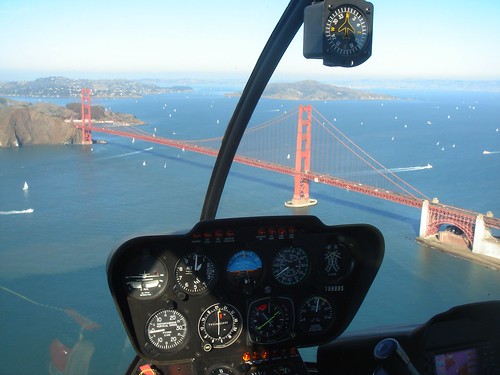
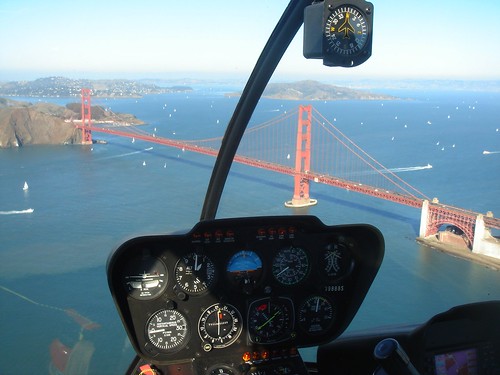
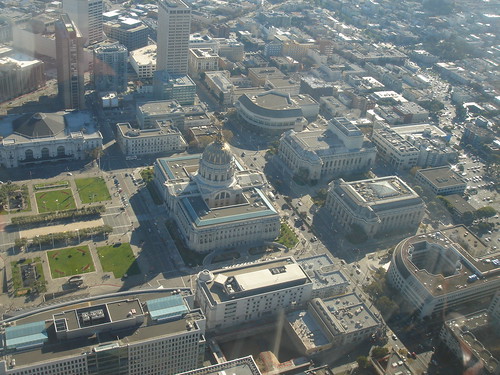
Well, almost exactly one year after my "discovery flight", I passed my PPL-H checkride and became a qualified helicopter pilot. To my pleasure and surprise, my wife - who has never been at all keen on helis and until now has never flown in one - agreed to be my first passenger. So last weekend I did my first helicopter "Bay Tour", departing from Palo Alto towards the coast, with a slight detour to fly over the Montebello Ridge vineyards so she could see them from the air. Then out to San Gregorio, up the coast over Half Moon Bay, over the Golden Gate and back over the city. I've done this numerous times in airplanes, but the view from the heli is much better and of course you're lower too. The flight was a success from all points of view, with a very happy passenger who agreed - despite her attachment to our plane - that this was even better.

One of the hardest parts of flying helis, for me anyway, was to get a really smooth pickup. Hovering seems impossible at first, but after about five hours it's under control and getting better. Autorotations are fun, and if you're used to landing the Pitts then they don't seem too dramatic. Getting them right is tricky and takes some fairly aggressive manouvering, and (in my opinion) you can never practice them enough. But in the end, pickups were the hardest.

Here's the problem. While you're sitting firmly on the ground, the position of the controls isn't affecting anything. Hence, you have no feedback about whether they're in the right position or not. As soon as the skids completely leave the ground, you're flying, even though you're only an inch off the ground, and everything depends on the position of the cyclic and the pedals. A touch too much left cyclic and right pedal, and you're whizzing off to the left while spinning round to the right - not good, especially if you're in a confined area or on soft ground.

Instructors and textbooks say the same thing - lift the collective slowly until you're "light on the skids", correct the control position, then lift further. Easy to say, harder to get a feel for. It's just like learning coordinated turns in a plane - the instructor says, "but surely you can feel it, without even looking at the ball?" And you say (or at least I did), "errr, no, I can't". Now I can feel it, after over 1000 hours and 100+ hours of aerobatics, but it took a while.

So my experience was, you so-so-gently pull up on the collective, waiting to feel the heli come alive as the weight comes off the skids. And then it starts to turn or to move, and in an instant of panic you yank up the collective and you're three feet off the ground and you've zoomed off several feet from your starting point, before you brought things back under control. This is not the way to pass a checkride, something my instructor made very clear to me.

The fix, for me, was an exercise where I deliberately set the cyclic and the pedals way off where they should be, then, as the collective came up, gradually corrected them as I felt things starting to move. After a few times doing that, I'd overcome the panic instinct to yank on the collective, and after that it was just practice. It's very satisfying - now that I can feel what "light on the skids" means - to make small corrections just before the thing leaves the ground, and have it move smoothly and vertically through those first few inches.

The other hard thing, getting close to the checkride, was slope work, where you delberately have the weight partly supported by one skid and partly by the rotor. The amazing videos you see of helicopters touching a steep hillside, yet still flying, are all about this. Again it's all about feel for the controls during the critical moments, and tiny movements of the collective. It's a real feeling of victory when you can hold the heli, half on the ground and half off, then sooo gently let it down onto the other skid. And even better when you can smoothly lift it off again. It takes a lot of practice.

Finally, a couple more pictures from our Bay Tour. There are more on Flickr.


Tuesday, 19 May 2009

Off Airport


The two main reasons for using a helicopter, rather than an airplane, are (a) to land where there is no runway and (b) to hover in place. So, naturally enough, these form part of helicopter training. Tonight we did a bit of both. Both are harder than they look. We went out to a remote area and landed on hilltops and on gravel tracks. After circling round to look for animals, power lines, fences, people, houses and so on, you try to land on a hilltop. Compared to an airport (a) you don't know the altitude, so you have to judge everything by eye (b) it's surrounded by hills and other inconvenient obstacles (c) typically there are trees whose distance from the target you have to judge from afar (d) surfaces look deceptively smooth until you get up close. So when we finally got to a landing hover above our first chosen location, we realised that the grass was eighteen inches high. Probably you COULD land there if someone's life was at stake, but it's too risky for a training exercise - you have no idea what is under the grass until you get the skids on the ground, and there's always the risk of tail-rotor damage.

Off to the next place. We find a gravel track winding around the contours of some hills, and make a couple of approaches to it. But the chosen landing spot looks awful small until you get very close in. It's hard to believe you can get this big helicopter (relatively speaking) into that tiny postage stamp of gravel, surrounded by trees. I confess that as my instructor flew the short final I had visions of our rotor blades thwacking into the adjacent bank (forgot to mention that part). In fact there was plenty of room, or adequate anyway. But then you have to get off again, with said bank directly in front and trees on either side. No problem (if, like my instructor, you have 10,000 hours of heli time) - lift off into a 5 foot hover, 180 degree pedal turn, and swoop back off the way you come. But it takes nerve and experience - which of course is what the training is all about.

We survived all that, and went off to practice high-altitude hovering - OGE is the technical term, short for "out of ground effect", i.e. far enough away from the ground that it doesn't interfere with the down-draft from the rotor, which provides extra lift when close to the ground. It's surprisingly hard to enter a hover smoothly. For a fixed-wing pilot the idea of stopping just doesn't come naturally, so as the airspeed gets down to 40 knots or so it already feels like you're standing still. It takes very careful control of the cyclic and collective to get to zero airspeed without losing control of altitude - either climbing or descending. We were doing this just under a Class B shelf, which made it more important not to gain altitude - as my instructor pointed out rather forcefully when I got to within 100 feet of it.

Then you have to stand still. The ground is a long way away when it comes to judging position to within a few yards, and a 25 knot headwind didn't make it easier. The GPS helps a lot, although you have to remember that a ground speed of 10 knots can be in any direction - the GPS doesn't know which way the heli is pointing.

So after a bit of practice at that, we took advantage of our hover to practice "settling with power" also called "vortex ring state". This is one of the peculiarities of helicopters. If you descend too fast with very low airspeed, the rotor falls into the downward-rushing column of air that it is creating itself - and stops providing any lift. Recovery, as long as you have enough altitude, is similar to stall recovery in an airplane - push the nose down and accelerate out of it. If you don't have enough altitude, you will hit the ground very hard - which is why it's best to practice at altitude (also like stalls).

Then back home. If all goes well, my next flight will be another solo.

Sunday, 17 May 2009

Helicopter Solo!


Well, I did it! Today, after exactly 24 hours of helicopter dual, I soloed. You might reasonably wonder what consititutes a solo in a heli... three two foot hovers? But it's just like fixed-wing, three times round the traffic pattern. Except that each take-off involves a clearing turn, so actually it counts as six landings.

As with my other solos (fixed wing, and the Pitts), I was so concentrated that I didn't remember to be nervous. That's probably a good thing. Disappointingly, I didn't get to see the Collings B-17 taking off from adjacent Moffett Field during my solo - things seem to be very quiet there this year.

The first five hours or so of heli training are about the most humbling experience you can have, in flying anyway. The aircraft seems completely uncontrollable as you zoom backwards, forward and sideways, desperately trying to stand still and failing utterly. Then, when you've oscillated too far from your spot, a 10,000 hour instructor takes the controls and with perfect precision plops you back in exactly the right place, before saying "your controls". And it starts all over again.

Actually flying the heli isn't too bad, at least if you have airplane experience. In flight it behaves pretty much the same, except that it is a lot more sensitive to the slightest movement of the controls.

Most of my 24 hours dual time, once I could take off, hover and land with reasonable accuracy, was spent on emergency procedures. Mainly, this means autorotations. A heli will fly just fine without an engine, though not for long, and unlike an airplane, it doesn't need a runway. I think autos are probably terrifying at first - unless you are used to landing the Pitts, in which case they seem very gentle.

Now on to 10 hours of solo, 3 hours of night flight, and more emergency procedures...